


REMNANT SEASON 01 FIELD NOTE
The hidden economy of pre-positioned ambushes in a collapsed America.
There is a particular kind of building that exists in every American town. You have driven past it a hundred times without noticing it. A strip-mall grocery store with the front windows soaped over. A box hardware store with the sign half pulled down. A gas station with the pumps wrapped in police tape. A pharmacy whose franchise pulled out three years ago. A church that closed when the congregation moved to the suburbs.
In normal times, these buildings are nothing. Real estate problems. Tax write-offs. Backdrops in your rearview mirror.
In collapse, they are the most dangerous square footage in the country.
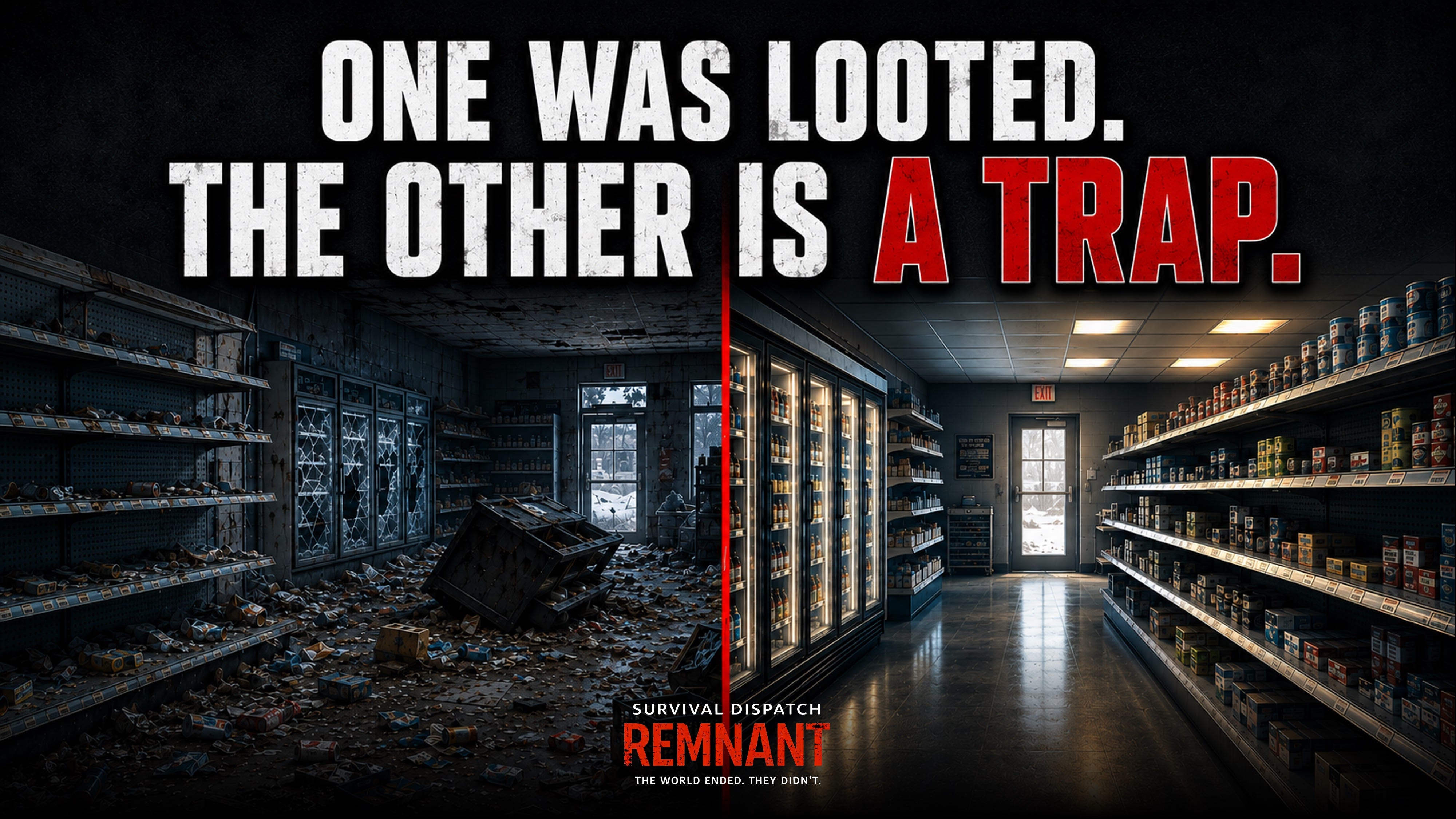
Because the people who survive the first thirty days of a real grid-down event do not survive by being kind. They survive by being early. And the men and women who understand what abandoned structures actually are — what they hold, what they hide, and how to weaponize them — get to the buildings long before the families do. They set up. They wait. And they let the families come to them.
This weekend, on Episodes 9 and 10 of Survival Dispatch: Remnant, the Smith family walks into a building that looks empty. The roof is intact. The windows are blown out. The cash registers are smashed open. Every aisle has been gone through at least once. The kind of place a probationary supply foray from a survival camp would mark on a map and call low-risk because the obvious threats have already been picked through.
The store is not low-risk.
The store is the trap.
LISTEN TO EPISODES 9 & 10 THIS WEEKEND
SurvivalDispatchRemnant.com | New episodes every Sat & Sun
The Grocery Store Raid & No Safe Haul
Why Predators Love Buildings Families Think Are Cleared
The first thing any serious predator does, in any collapse scenario, is the same thing serious infantrymen have done in urban combat since Stalingrad. They find a structure that draws people in, they map its sight lines and choke points, they identify its predictable approach routes, and they wait for the people who think they are doing the hunting to walk into a position where they are being hunted instead.
Grocery stores are perfect for this. Hardware stores are perfect for this. Pharmacies and gas stations and shuttered restaurants and abandoned churches are perfect for this. They share a set of architectural qualities that turn them, in a collapse, into killing grounds disguised as opportunities.
Wide single-entry storefronts. Narrow back-of-house corridors. Stockrooms with one way in and one way out. Roof access via internal stairwells. Loading docks that hide who is coming and going. Aisles that channel movement into predictable paths. Cash registers and pharmacy counters that draw eyes away from elevated firing positions on mezzanines and stockroom rafters.
Normal foot traffic in an abandoned grocery store, in a collapse scenario, follows almost exactly the same path the first three families followed. Everyone goes for the canned goods aisle first. Everyone checks the pharmacy second. Everyone hits the back stockroom third. A predator who has been inside the building for two weeks knows that sequence by heart. He has marked the firing angles. He has rehearsed the kill zone. He has decided which family he is going to take first.
And the families never see it coming, because the building looks like every other building they have already cleared safely. Familiarity is the camouflage.
On the difference between scavenging and being scavenged: A man who walks into a building expecting to find food finds whatever the man who got there first decided to leave for him. Sometimes that is canned vegetables. Sometimes that is a sight picture through a stockroom door. The buildings do not change. The men inside them do.
The Five Signs a Building Is Not What It Appears
Experienced post-collapse operators — the people who have studied urban combat from Mogadishu to Fallujah to the gang-controlled neighborhoods of Caracas — consistently identify a set of signals that a building that appears abandoned has actually been claimed and pre-positioned by someone who got there first. These are not exotic indicators. They are the same details that infantry small-unit leaders are trained to look for, and the same details that experienced criminals use to read each other’s territory.
Most American families have never been taught any of them. Most American families, in a real collapse, will walk past every single one of these signals because they look like nothing.
1. Selective scavenging.
A building that has been worked over by desperate families is gutted. Everything edible is gone. Every blanket is gone. Every battery is gone. Every aisle is a mess. A building that has been worked over by a predator is selective. The high-value items are gone — guns, medical, alcohol — but the bulk staples are still on the shelves, more or less in place. That is not because the predator missed them. That is because the predator is using them as bait.
2. Disturbed dust patterns.
Inside any abandoned structure, dust accumulates in predictable layers within 72 hours. A building that has been empty for two weeks will show a uniform dust layer on every horizontal surface — counters, shelves, floors, equipment. A building that has someone living inside it will show interruptions. Footprint patterns on the floor that don’t match the obvious entry routes. Smudges on counters in the back where no scavenger had reason to lean. Disturbed dust on a stockroom door handle that visibly hasn’t been opened from the outside in days. These details are easy to miss and almost impossible to fake.
3. Pre-cut sight lines.
A predator who intends to ambush from inside a building will cut sight lines through the merchandise. He will tip over a specific shelf to create a firing lane. He will pull a specific endcap to open up an aisle. He will remove a specific piece of plywood from a back office wall to give himself a viewing slit into the main floor. These modifications look, to an untrained eye, like the random destruction of a looted store. They are not random. They are engineered. And the moment you recognize one of them, you should already be moving.
4. Trash that doesn’t match the timeline.
Every abandoned building has trash. Wrappers, broken packaging, water bottles, food scraps from the first wave of scavengers. But trash has a timeline. Food scraps decay. Water bottles dry out. Wrappers fade. A building that appears to have been empty for weeks but contains fresh food residue, recent cigarette butts, or moisture-damp cardboard is a building that has someone in it right now. The trash is the timestamp the occupant forgot to clean up.
5. Wrong-temperature surfaces.
This one is the rarest and the most reliable. In a building without power, every surface eventually equalizes with the ambient air temperature. A car hood that was driven recently is warm. A stockroom door handle that someone has gripped within the last hour is warm. A patch of concrete floor where a man has been sitting against a wall is warm. A trained operator brushes the back of his hand across surfaces as he moves through a structure not because he is checking for clues but because human heat is the one signature that the occupant cannot edit, hide, or rearrange. Cold buildings stay cold. Warm spots are people.
Episode 9 places the Smith family inside a building that is showing two of those signals before they ever walk through the front door, and a third one before they reach the back of the store. Mark Smith reads one of them. The veteran Camp Ridge scouts on the foray read another. And one member of the family reads the third one before any of the trained adults do — and his name is in the cast list for a reason.
The episode is built around what happens after the third signal is identified, but before the family has time to act on what it means.
SUBSCRIBE TO SURVIVAL DISPATCH: REMNANT
The full framework, the five questions every family should answer before the first foray, and the price the Smiths pay this weekend — for paid subscribers.
SurvivalDispatchRemnant.com | New Episodes Every Sat & Sun
— THIS ARTICLE CONTINUES FOR PAID SUBSCRIBERS —