


REMNANT SEASON 01 FIELD NOTE
Sarah Smith spent two years preparing for a moment she hoped would never come.
Not because she was afraid. Because she was paying attention. While Mark was going to work and the kids were going to school and the neighborhood was running the quiet routine of ordinary suburban life, Sarah was building a preparedness protocol in the garage. Tubs of water. A hand-crank radio. Medical supplies. Plastic sheeting and a staple gun. Mike Glover’s book on preparedness, which she gave Mark for Christmas and which he did not open.
She knew what the family needed. She bought it. She stored it. She organized it on metal shelving in a garage that smelled like motor oil and laundry detergent, and she never once made Mark feel stupid for not helping.
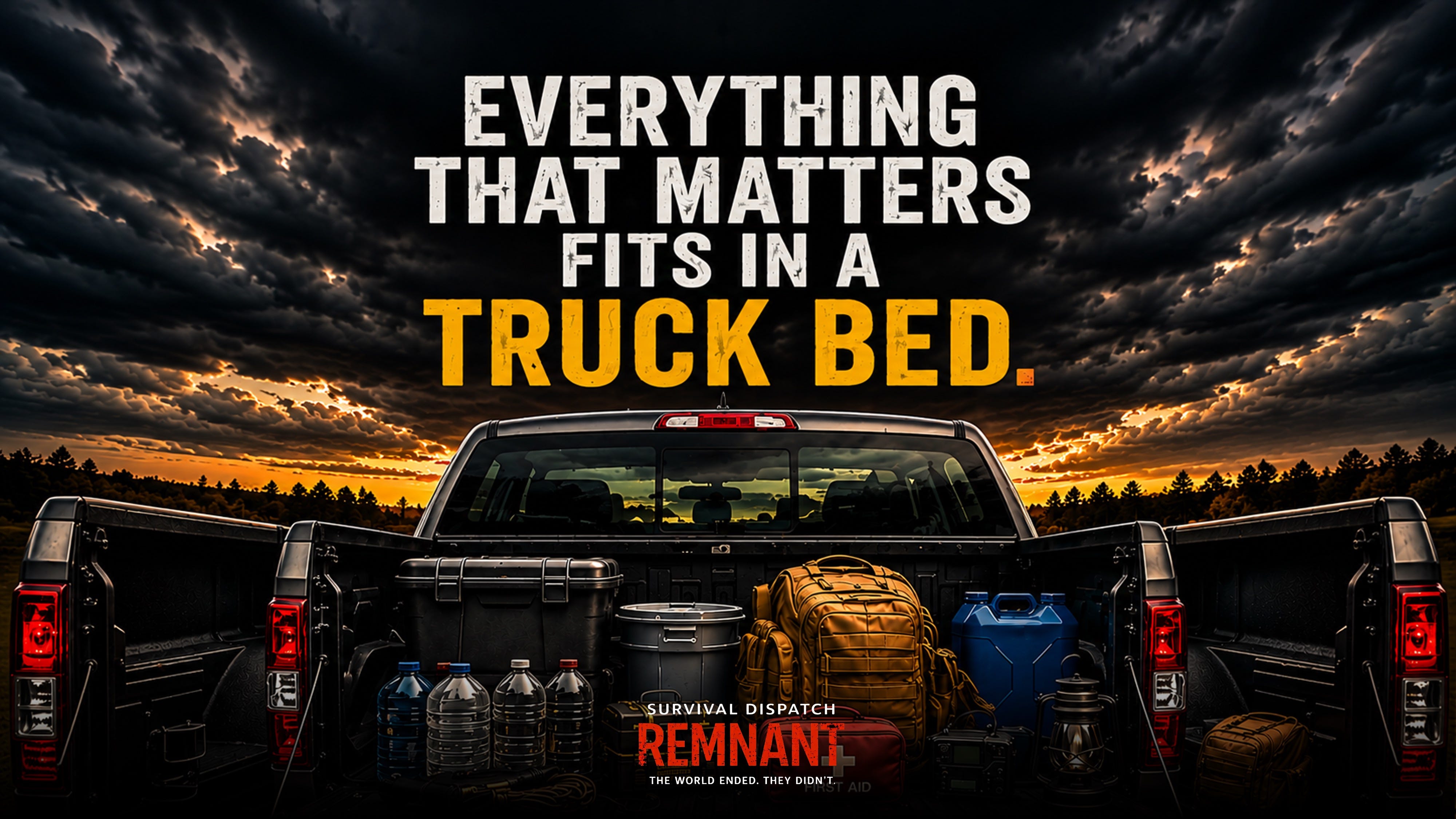
In Episode 7, they have twenty minutes to load what they can carry and leave the rest.
Survival Dispatch: Remnant is our audio drama following an ordinary American family through a nuclear collapse. A banker, a nurse, two kids, and a dog. Not preppers. Not operators. A real American family finding out what they are made of. Episode 7 drops tomorrow. Episode 8 drops Sunday.
This week closed with the question every family in a collapse eventually faces.
Not what do you take. What do you leave.
LISTEN TO EPISODES 7 AND 8 THIS WEEKEND
The House on Fire and The Highway Graveyard
SurvivalDispatchRemnant.com | New episodes every Saturday and Sunday
THE THREE PRIORITIES THAT ARE NOT NEGOTIABLE
Vehicle load discipline is not a packing preference. It is a survival decision framework, and it has to be built before the twenty-minute clock starts. Once the smoke is moving and the truck is running and children are asking questions and a dog is underfoot, the time for thinking about what matters most has already passed.
Experienced preppers, military personnel who have conducted evacuations, and emergency management professionals who have studied post-disaster behavior all arrive at the same three-tier priority structure. Not because it is elegant. Because it is what keeps people alive when everything else is on fire.
Priority One: Water and filtration.
A human being can survive approximately three weeks without food and approximately three days without water. In a high-stress, high-output collapse environment, that three-day window compresses significantly. Water is the first thing on the truck and the last thing you leave behind. If a choice has to be made between water and anything else in the first two categories, water wins. Filtration capability — a quality gravity filter, iodine tablets, a quality pump filter — extends your water security beyond what you can physically carry and is load for load the highest-value item in a bug-out kit.
Priority Two: Medical.
Sarah Smith’s nursing background makes the Smith family’s medical capability exceptional. But even without a registered nurse in the household, a well-stocked trauma kit, a supply of critical medications for every family member, and the knowledge to use what you are carrying will determine outcomes that nothing else can address. Wounds happen in collapse environments. Infections follow wounds. The family that can address a wound on the road is the family that keeps moving. The family that cannot is the family that stops.
Priority Three: Security.
A firearm you know how to use and ammunition to sustain a sustained defensive encounter. Not a collection. Not a display. One primary long gun and one sidearm per capable adult, with sufficient ammunition to mean something if the situation requires it. The security load also includes communication — a battery-powered or hand-crank radio, a way to monitor what is happening on the road ahead and around the position you stop at.
Everything else is weight.
That sentence is easy to write and very hard to live. Because everything else includes the things that are not survival items but are the artifacts of a life you built. And leaving them behind is not just a logistical decision. It is a grief.
On load discipline:
The things you feel worst about leaving behind are almost never in the three priority categories. That is not an accident. It is the difference between what keeps you alive and what made life worth living. In a collapse you are buying time to get back to the second category. Load for the first.
SUBSCRIBE TO SURVIVAL DISPATCH REMNANT
Route selection, movement discipline & what Jake sees that Mark misses
SurvivalDispatchRemnant.com | New Episodes Every Sat & Sun
— THIS ARTICLE CONTINUES FOR PAID SUBSCRIBERS —