


REMNANT SEASON 01 FIELD NOTE
The house is on fire. The truck is packed. The family is waiting.
And Mark Smith still doesn’t want to go.
That is not a character flaw. That is a feature of the kind of man who builds things, protects things, and refuses to quit when the pressure comes. In peacetime, that instinct is what separates the men who provide from the men who drift. In a collapse, if it goes ungoverned, it is exactly what gets a family killed.
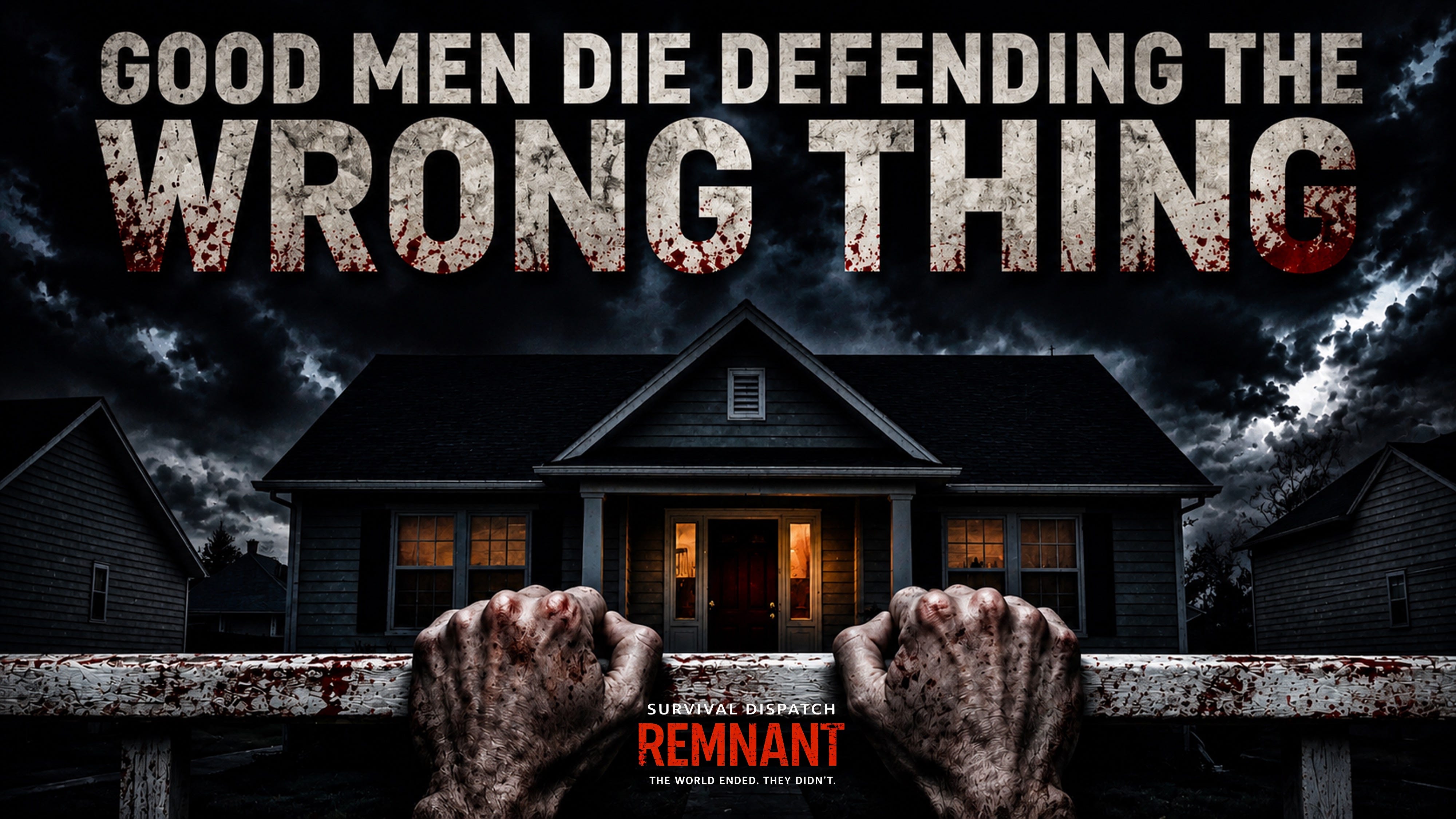
Survival Dispatch: Remnant is an audio drama following the Smith family through a nuclear collapse scenario. Not operators. Not preppers. A 40-year-old banker named Mark, his wife Sarah who is a registered nurse, their teenage son Jake, their 12-year-old daughter Emily, and a dog. An ordinary American family dropped into the worst situation imaginable, finding out who they actually are.
Episode 7 drops this Saturday. It is the episode where Mark makes the hardest call of the collapse so far. Not tactical. Not logistical.
Psychological.
He has to let go of the house. And the reason it costs him what it does is worth understanding before you ever find yourself in a version of the same moment.
LISTEN TO EPISODE 7 THIS WEEKEND
He Doesn’t Want to Leave
SurvivalDispatchRemnant.com | New episodes every Saturday and Sunday
THE INSTINCT THAT BUILT THE NATION
There is a reason men anchor to place. It is not ego, though it can become ego. It is something older and more useful than that.
The man who builds a home, defends a property, and refuses to abandon his ground is operating from an instinct that has kept families alive across every generation of human history. It is the same instinct that built every farmhouse, every frontier settlement, every neighborhood in every American suburb. You find a piece of ground, you make it yours, you protect it, and you do not leave it for anyone.
Mark Smith is that man. He is the kind of man who shows up, who commits, who does not walk away from things he has decided matter. For 19 years of marriage that instinct has served his family well. He showed up. He provided. He stayed.
The collapse did not break that instinct. It just stopped rewarding it.
That gap between an instinct that is genuinely good and a situation that has rendered it lethal is one of the most dangerous places a man can be. Because he is not wrong to feel what he feels. He is wrong to let it make the decision.
On the instinct to hold ground:
The same quality that makes a man worth following in peacetime can make him impossible to reason with in a crisis. The instinct is not the problem. The inability to govern it is.
WHAT THE HOUSE ACTUALLY MEANS TO HIM
To understand why leaving costs Mark what it does, you have to understand what the house represents to him.
It is not sentiment. Mark is not a sentimental man. He does not linger over family photos or get emotional about square footage. The house matters to him for a different reason entirely.
It is the last thing he controls.
From the moment the skyline went orange on Day Zero, Mark has been managing chaos he did not create and cannot fully predict. The grid is down. Communications are gone. The neighborhood is fracturing. People are making catastrophic decisions all around him. In the middle of all of that, the house is the one variable he has actually shaped. He knows every entry point. He knows the angles. He knows where the threats come from and how to answer them.
Leaving the house does not just mean abandoning a structure. It means stepping off the only ground in the world where Mark Smith currently knows what he is doing.
That is what Episode 7 actually costs him. Not the house. The illusion that he still has something figured out.
WHY SARAH SEES IT BEFORE HE DOES
Sarah Smith has been the family’s survival engine since before Mark accepted what was happening. While he was still analyzing, she was acting. While he was still processing the scale of the collapse, she was pulling supplies from the garage tubs she had stocked two years before Day Zero when he was not paying attention.
She sees the house differently than he does. To Sarah it was always a tool, not an anchor. She built a preparedness protocol around it, not an identity. When the tool stops working she is ready to put it down. Mark built something different inside those walls. Something harder to walk away from.
This is not a criticism of Mark. It is an observation about how men and women often relate differently to place and identity. Sarah’s faith is what grounds her. It was grounded before the collapse. Mark’s faith was nominal at best, and the thing that was grounding him instead was the sense that he had built something real and defensible.
When that thing has to be abandoned, he has nothing to replace it with yet.
That is the actual story of Episode 7. Not the fire. Not the bug-out. The beginning of Mark Smith finding out what he actually believes when everything he built is gone.
SUBSCRIBE TO SURVIVAL DISPATCH REMNANT
What Mark finds on the other side of letting go — for paid subscribers.
— THIS ARTICLE CONTINUES FOR PAID SUBSCRIBERS —