


REMNANT SEASON 01 FIELD NOTE
When the Smiths loaded the truck in Episode 7, they did not debate whether to take him.
Casey went in the cab. No discussion. He has been with this family for four years and he weighs 110 pounds and he is not the kind of animal you leave behind when the world ends. That was not a survival calculation. That was a family decision.
But here is what makes Casey more than a family member on the road: he is also one of the most tactically valuable assets the Smiths are traveling with. He is better at his job than most people understand, and the job he does is one that no piece of gear in the truck bed can replicate.
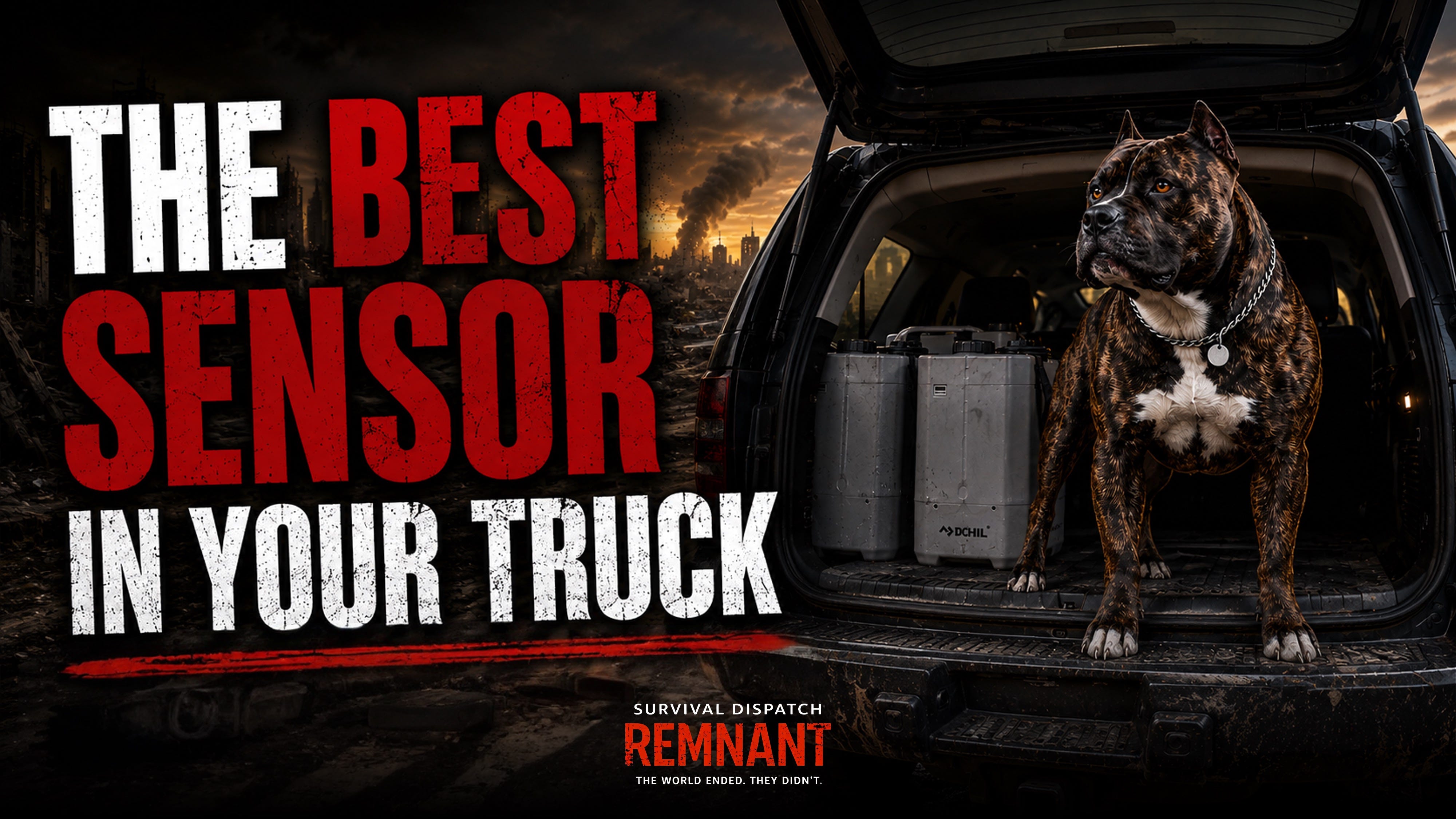
Survival Dispatch: Remnant is our audio drama following an ordinary American family through a nuclear collapse. A banker, a nurse, two kids, and a 110-pound American Pit Bull Terrier, finding out what they are made of when nothing works anymore. Episode 7 drops Saturday. Episode 8 drops Sunday.
This week we are talking about the dog.
Not sentiment. Capability. Because the collapse does not care what you feel about your animal. It only cares what your animal can do when something is wrong and nobody else has figured it out yet.
LISTEN TO EPISODES 7 AND 8 THIS WEEKEND
The House on Fire and The Highway Graveyard
SurvivalDispatchRemnant.com | New episodes every Saturday and Sunday
WHAT CASEY ACTUALLY DOES
A working dog in a collapse environment does not perform tricks. He does not need commands for most of what matters. He is doing his job continuously, automatically, and without being asked, and that job is environmental sensing at a level no human being can match.
Dogs hear frequencies humans cannot detect. They process smell at a sensitivity estimated to be ten thousand to one hundred thousand times more acute than human olfactory capability. They sense changes in air pressure, body temperature, and chemical signals that humans have no conscious access to at all. When Casey stops, stiffens, and orients toward a treeline, he has already processed information that will not be available to Mark for another thirty seconds minimum — if it becomes available to Mark at all.
In a collapse environment, those thirty seconds are not a minor advantage. They are frequently the difference between making a decision and reacting to one someone else already made for you.
This is what Casey provides. Not protection in the movies sense — he is not a weapon system that gets pointed at threats and fired. He is a sensor array that has been integrated into the family’s daily environment for four years and whose signals the family has learned to read without thinking about it. When Casey is relaxed, the environment is probably clear. When Casey is not relaxed, the environment is not clear. That information costs nothing and requires no power source and does not fail when the grid goes down.
On early warning:
The best early warning system you can own runs on food and water, sleeps in the cab with your family, and has been calibrated to your specific environment for years. No battery required.
The Liability Side of the Ledger
A 110-pound dog on a bug-out is not free. Anyone who tells you otherwise is not being honest about the math, and the math matters when every pound in the truck and every gallon of water has a competing use.
Casey eats. On a normal day he goes through roughly four to five pounds of food. In a high-output collapse environment — moving, alert, working — that number goes up. Water requirements scale similarly. The Smiths are already managing water discipline for eight people including two adults, two children, and the Moon family. Adding a large working dog to that equation is not trivial.
Casey also draws attention. A 110-pound Pit Bull Terrier is not an animal that disappears into a crowd. In a collapse environment where the Smiths need to move with as low a signature as possible, Casey is a visibility problem. People notice him. Some of them are frightened by him. A frightened person in a collapse is not a predictable person, and an unpredictable person with a weapon is a threat that Casey himself may escalate.
Casey makes noise when he chooses to. That is almost always the right choice. But almost always is not always, and there are situations in which a large dog barking at the wrong moment is the thing that reveals a position that had been successfully concealed.
None of this is an argument for leaving Casey behind. It is an argument for planning around his presence rather than ignoring it.
SUBSCRIBE TO SURVIVAL DISPATCH REMNANT
Route selection, movement discipline & what Jake sees that Mark misses
survivaldispatch.substack.com | New episodes every weekend
— THIS ARTICLE CONTINUES FOR PAID SUBSCRIBERS —