


FIELD NOTE
Casey has not come off the inner wire. It has been hours now. He will not settle, he will not take food, and he will not come when he is called, which is a thing the dog has never once refused to do. He is locked on the black timber behind the camp, hackles up, the low sound running steady under his ribs, fixed on a line of trees that gives back nothing at all to any man who walks down to the wire and looks. There is no movement in it. There is no shape in it. There is only a dog who is certain, a tree line that will not confirm him, and the gap between those two things widening by the hour.
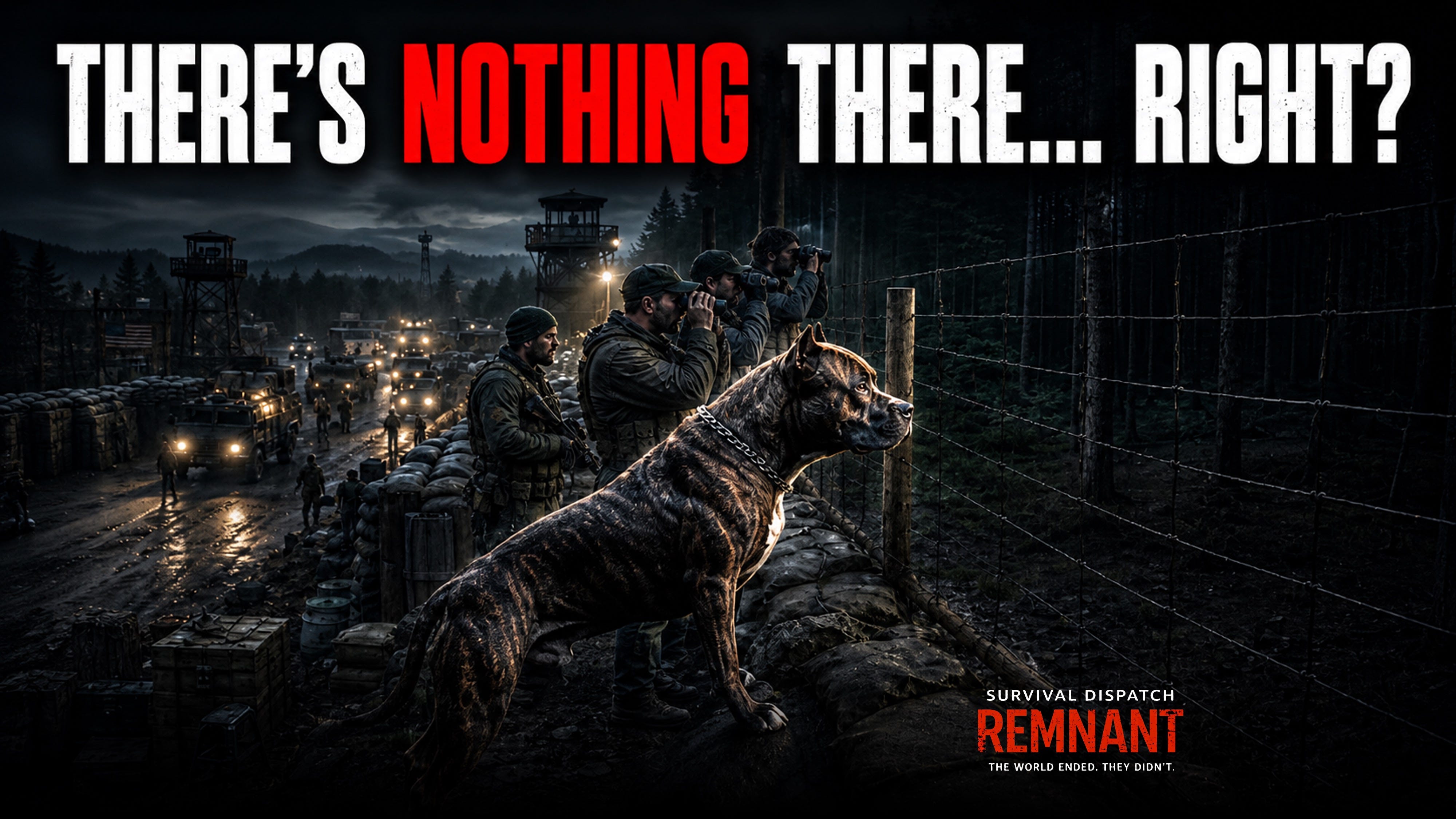
The pull to wait is not foolishness. It is economy. A camp has a fixed number of hands and a fixed number of hours, and an army on the road in front of it that demands both. Pulling men off that visible threat to chase a dog’s certainty into an empty tree line carries a real price, and if the tree line truly is empty, that price bought nothing. Worse, a camp that scrambles its whole defense every time the dog gets worked up teaches itself, slowly, to stop scrambling, and a watch that has cried wolf at itself too many times is a watch that will be slow on the morning the wolf is real. So the senior men do the reasonable thing. They wait for the tree line to give them something to act on. They wait to be sure.
The problem is that waiting to be sure is a decision, and it is not a free one, and the bill for it does not come due until later. The whole danger of a warning that will not prove itself is that the proof, when it finally arrives, tends to arrive in a form a camp cannot use, because by then the thing the dog found has finished closing the distance and is no longer a warning to be acted on but a situation to be survived. The window a camp spends deciding whether it is sure is the same window the threat spends getting into position. The two are the same stretch of time. One side is using it to debate. The other side, if there is another side, is using it to move.
This is the oldest hard lesson in the discipline, and it never gets easier to obey. You cannot run a perimeter on the policy of waiting until you are certain, because certainty is the one thing a careful threat will never hand you until it is too late to matter. The cost of acting early on a false alarm is small and it is recoverable, some lost sleep and some men moved for nothing and a watch that grumbles. The cost of acting late on a real one is neither of those things. The math is lopsided, and it always points the same direction, and the reason camps get caught out anyway is that the cheap mistake is the one you make in plain sight in front of everyone, and the expensive one is the one nobody can see coming until it is already standing on the ridge.
Camp Ridge is standing inside that exact window right now. The dog is sure. The tree line is empty. The clock is running, and every hour that passes without proof makes the reasonable case for waiting a little stronger and the price of having waited a little higher. Which way the camp moves, and what the moving or the waiting costs it, is what EP015 is built around. It releases this Saturday. Part 1 Saturday. Part 2 Sunday. SurvivalDispatchRemnant.com.
SUBSCRIBE TO SURVIVAL DISPATCH REMNANT.
Season 1 runs two parts to an episode. Paid subscribers get each part the day it drops. Free subscribers wait a week.
The field note continues below for paid subscribers.