


REMNANT SEASON 01 FIELD NOTE
The camp had men on the line. The camp had veterans. The camp had people who had been watching that tree line for days. And not one of them saw it first.
There is a specific failure mode that every experienced observation post eventually develops, and it is the failure mode that nobody in the post can see from inside it. The veterans who have been watching a particular threat environment long enough to read it fluently have also been watching it long enough to start filtering it. The brain that spent three days cataloguing the tree line in front of Camp Ridge has built a model of that tree line. It knows where the shadows fall at dusk. It knows how the pine canopy moves in a light wind. It knows what the ground looks like at the base of the first two rows of trees when the light comes in from the northwest.
And because it knows all of that, it has stopped seeing most of it.
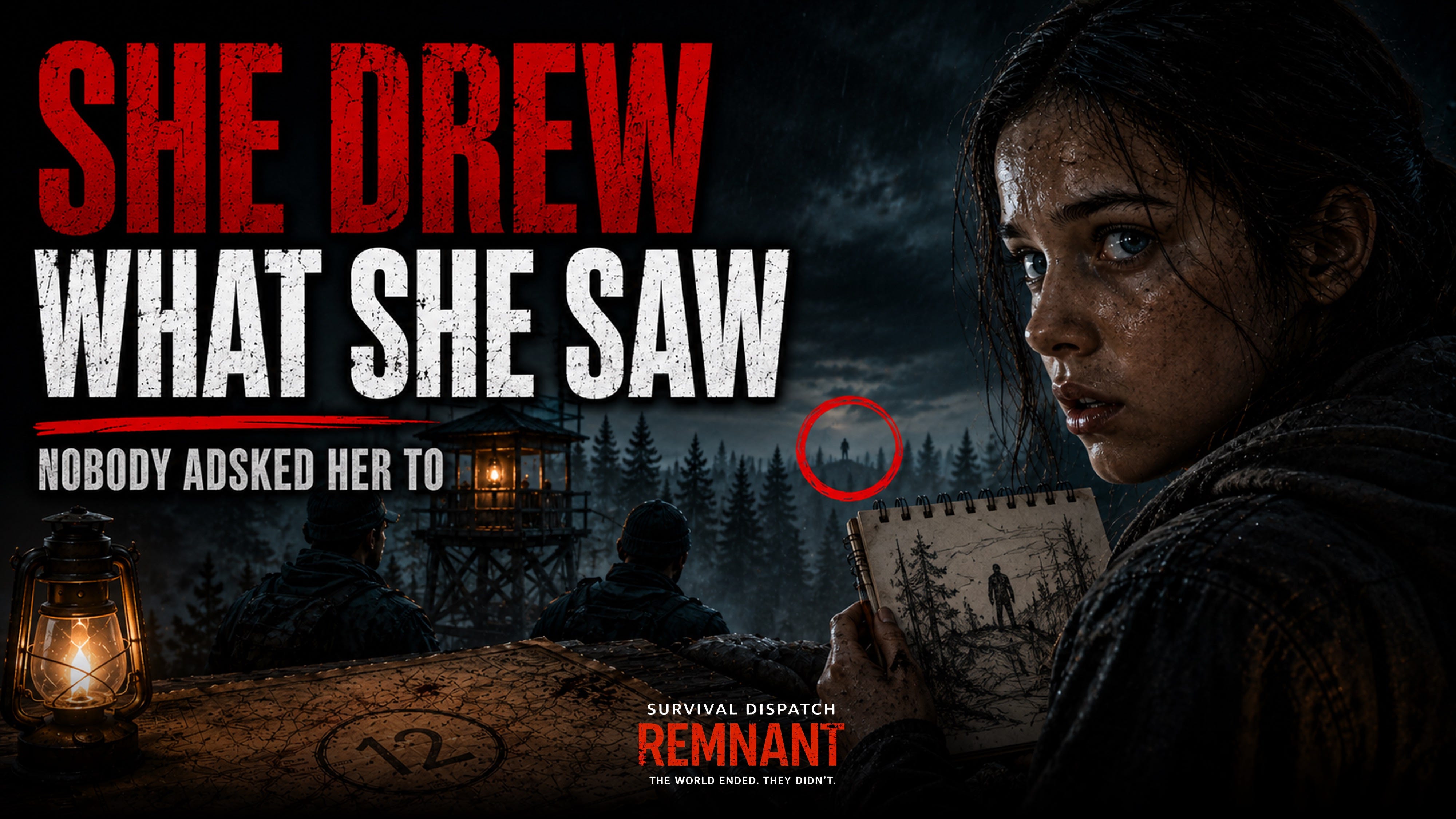
This is not a flaw in the experienced observer. It is a feature. The brain that has internalized a threat environment well enough to build a complete model of it can now process that environment at a fraction of the cognitive cost it took to build the model. The veteran watch can scan the tree line in four seconds and produce a credible threat assessment because most of what he is seeing matches the model he already has. His brain is not processing the tree line. It is comparing it to the model and flagging the differences.
The problem is what happens when the difference is small.
A threat that enters the environment gradually, in increments too fine to trip the veteran’s comparison threshold, can position itself completely before the model recognizes the delta. Not because the veteran is not watching. Because he is watching too well. The model he built is so accurate, and his comparison process so efficient, that a careful, patient, disciplined enemy can slide into the gap between what the model expects and what it will flag.
The person who sees that threat first is never the one with the most time on the line. It is the one who has no model. The one for whom every element of the scene is still raw data, uncompressed, unfiltered, seen exactly as it is rather than compared to what it should be.
That person is usually the one nobody asked.
LISTEN TO EPISODES 11 & 12 THIS WEEKEND
Night Breach (Sat) and The Girl Who Saw It First (Sun) on Survival Dispatch Remnant
New episodes every Saturday and Sunday
What Experienced Observers Miss and Why
The research on expert observation failure is consistent across disciplines, and it consistently points to the same mechanism. Experts do not miss things because they are not paying attention. They miss things because they are paying attention in a way that has become too efficient.
Radiologists with decades of experience miss anomalies on scans that first-year residents catch, not because the residents are better diagnosticians, but because the residents have not yet learned to route-process the scan. They look at everything. The experienced radiologist looks at the places where anomalies appear. When the anomaly appears somewhere else, the experienced observer’s routing sends him past it.
Air traffic controllers operating a familiar sector under normal-traffic conditions will miss a non-standard approach that a controller handling the sector for the first time would flag immediately, because the non-standard approach does not match any of the threat patterns the experienced controller has learned to screen for. The first-time controller has no screen. Everything is a potential threat. That is both his weakness and, in the specific scenario of an unprecedented event, his advantage.
Infantry veterans who have spent months in a specific terrain type develop a threat model for that terrain that is both their greatest tactical asset and their greatest vulnerability. A new contact who has studied that terrain model and learned to operate inside its blind spots does not have to defeat the veteran’s training. He only has to defeat the model the training built.
The pattern holds across every domain where experienced observers are responsible for detecting threats in familiar environments. Expertise produces accuracy, speed, and efficiency. It also produces filtering, routing, and a specific category of blindness that is invisible from inside the expertise.
Camp Ridge has been watching the same tree line since the family arrived. The watch rotation has been consistent. The senior observers have accumulated days of data on that specific environmental baseline. Their models are detailed and accurate. And a patient, disciplined enemy who has been studying those models from the outside can find the threshold below which the model does not flag the delta.
The most dangerous gap in any observation post is not between what the watchers can see and what they cannot. It is between what the watchers expect and what is actually there.
The Five Characteristics of the Observer Who Catches What Experts Miss
Across the documented cases where a non-expert observer detected a threat that experienced personnel missed, five characteristics appear consistently in the observer who made the catch. None of them require training. All of them can be developed deliberately, and all of them can be destroyed by the wrong kind of experience.
1. No established baseline.
The observer who has no prior exposure to the environment has no model to compare against. Every element of the scene is processed at full cognitive cost because none of it has been routed into an efficient comparison loop. This is exhausting and inefficient for sustained observation. It is also the only state in which a genuinely novel threat presents exactly as anomalous as it is, without any filtering applied. The fresh eye sees the tree line as it is. The experienced eye sees the tree line as it compares to the model.
2. Unstructured attention.
The experienced observer’s attention has been structured by training, by the threat model, and by the observation protocols of the position. He knows where to look. The unstructured observer does not know where to look, so he looks everywhere, in the order that draws his attention. That order is not tactically optimal. It is also not tactically filtered, which means it does not skip the places the threat model says anomalies do not appear. The unstructured observer’s inefficiency is his immunity to the model’s blind spots.
3. High sensitivity to wrongness without the ability to name it.
The experienced observer who notices an anomaly can usually name it within seconds. This is a strength in most scenarios and a weakness in novel ones, because the naming process is driven by the threat model. If the anomaly does not match any category in the model, the experienced observer will sometimes force it into the nearest category rather than holding it as genuinely unclassified. The inexperienced observer who notices wrongness cannot name it, so he reports it as wrongness. That report is often more accurate than the categorized report of the expert, because the expert’s categorization introduced distortion that the inexperienced observer’s discomfort did not.
4. No investment in the current assessment.
An experienced observer who has been watching the same threat environment for days has made assessments. He has reported those assessments. He has, in a practical sense, committed to them. A new anomaly that contradicts his previous assessment requires him to revise not just his model but his prior reports, which creates a subtle resistance that is not dishonest but is genuinely cognitively costly. The observer with no prior assessment has no prior commitment to protect. He reports what he sees without the friction of reconciling it with what he said yesterday.
5. The willingness to report without authority.
This is the characteristic most often absent in the scenarios where the fresh eye catches the threat but the threat is not acted on in time. The inexperienced observer sees something wrong. He does not have the positional authority, the tactical vocabulary, or the established credibility to make the report feel urgent to the people who receive it. He reports it anyway, or he does not, and the difference between those two outcomes has nothing to do with what he saw and everything to do with whether anyone in the position built a culture where unranked observers are expected and empowered to report anomalies regardless of their standing.
Calloway built that culture at Camp Ridge. It is one of the things the Smith family did not understand about the place when they arrived, and one of the things they will understand completely by the end of this weekend.
SUBSCRIBE TO SURVIVAL DISPATCH: REMNANT
What the observer who catches it is actually doing — and why the camp that listens to her is the camp that survives.
New episodes every weekend
— THIS ARTICLE CONTINUES FOR PAID SUBSCRIBERS —