


REMNANT SEASON 01 FIELD NOTE
The Smith family made it out.
They loaded the truck, left the house, and got moving before the fire could take the decision away from them. By every measure that mattered Monday morning, they did the right thing.
By Sunday night, they will wish the highway had been the easy part.
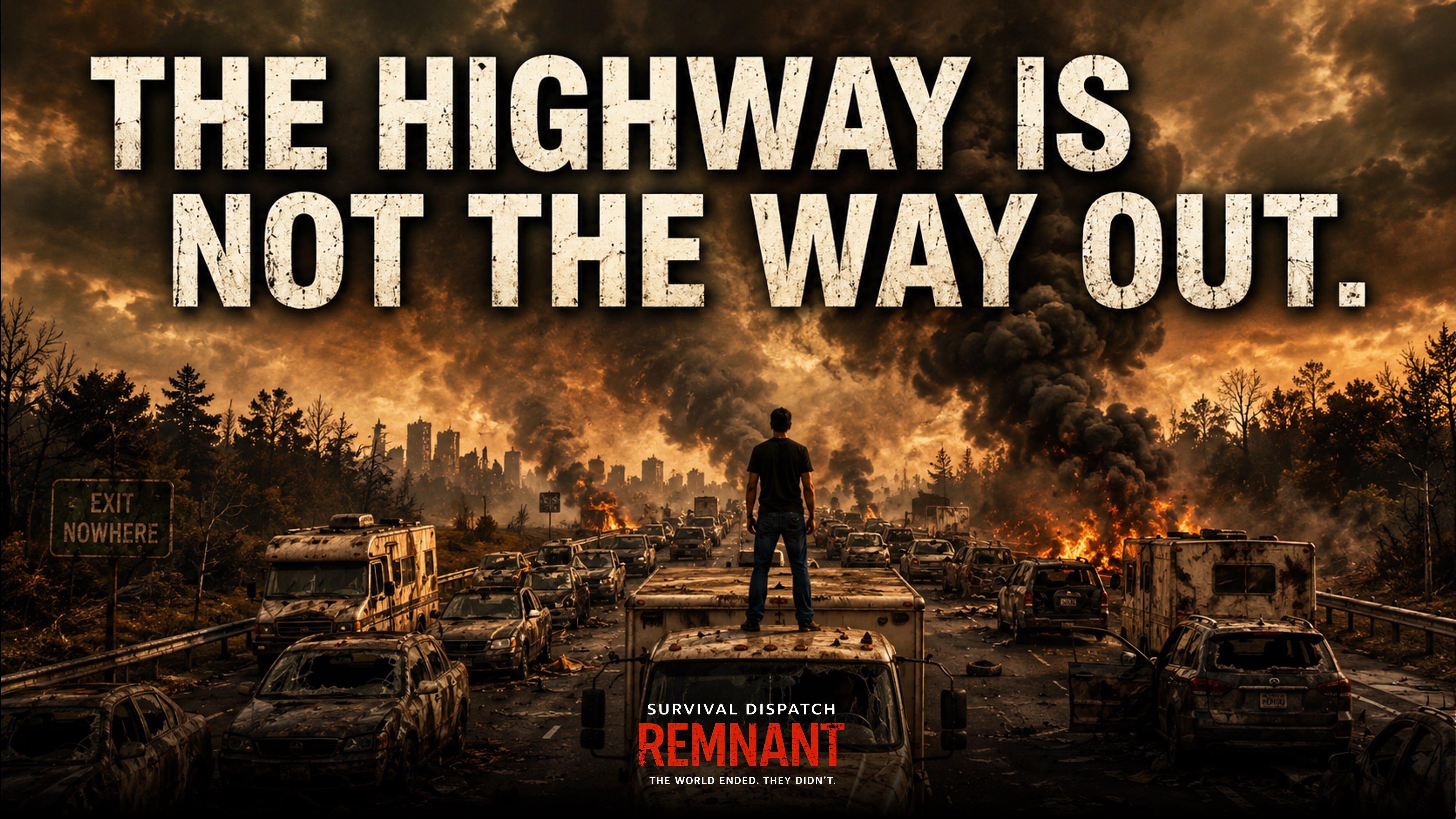
Survival Dispatch: Remnant is our audio drama following an ordinary American family through a nuclear collapse. Not preppers. Not operators. A banker, a nurse, two kids, and a dog, finding out who they are when the world stops working. Episode 7 drops Saturday. Episode 8 — The Highway Graveyard — drops Sunday.
Episode 8 is the one that will change how you think about evacuation routes.
Most collapse preparedness content treats movement as the solution. Get out of the city. Get off the grid. Get somewhere safer. What it almost never addresses is what happens on the road between where you are and where you are going — and why that road, in a real collapse, is frequently more dangerous than the position you just abandoned.
The highway is not a route. It is an environment. And like every environment in a collapse, it selects hard for the people who understand it and against the people who do not.
LISTEN TO EPISODES 7 AND 8 THIS WEEKEND
The House on Fire and The Highway Graveyard
SurvivalDispatchRemnant.com | New episodes every Saturday and Sunday
WHAT ACTUALLY HAPPENS WHEN EVERYONE RUNS
After Hurricane Katrina, the contraflow lanes on I-10 out of New Orleans moved approximately 1.2 million people in 38 hours before the storm. It was the largest peacetime evacuation in American history and it is held up as a logistical success.
What it is not held up as — because the conversation always ends before this part — is what happened on those highways to the people who did not get out before the lanes filled. People died in stopped cars in 100-degree heat. People were robbed at gunpoint on evacuation routes that had become linear traps with no exit. The Danziger Bridge shootings happened in the context of a city that had become a kill zone precisely because it had emptied of law and filled with desperation.
That was a hurricane. One event, one city, one week.
A nuclear collapse does not give you contraflow lanes. It does not give you the National Guard on the on-ramps. It gives you every family in the affected area making the same decision at the same time with the same information, which is almost none, pouring onto road infrastructure that was already at capacity before a single car stopped moving.
The highway becomes a graveyard not because of a single catastrophic event but because of the accumulation of ten thousand small desperate decisions made by people who thought movement meant safety.
On the difference between movement and escape:
Getting in the truck is not the same as getting out. Movement without a destination, a route, and criteria for when to stop is not evacuation. It is relocation of the problem.
THE SIX WAYS A HIGHWAY KILLS YOU
The Smith family discovers most of these in Episode 8. You do not have to wait until Sunday to understand them.
1. Choke points.
Every on-ramp, overpass, bridge, and tunnel on a major evacuation route is a choke point. In normal traffic they are minor friction. In a collapse they are kill zones. A stalled vehicle, a deliberate obstruction, or a coordinated ambush at a choke point does not just stop the vehicle it targets. It stops every vehicle behind it. The people in those vehicles are then stationary, exposed, and unable to retreat without reversing into the same trap they just drove into.
2. Predictability.
Everyone going the same direction on the same road at the same time is not a crowd. It is a pattern. Patterns are exploitable. The people who figured out early that evacuation routes create predictable traffic are the same people who positioned themselves at the right spots before the traffic arrived. The Smiths are not the only ones who understood that people would need to move. They are just the ones the story follows.
3. Fuel exposure.
A vehicle that runs out of fuel on an evacuation route is a stationary target with a family inside it and supplies in the bed. Fuel discipline — knowing your range, knowing where resupply is possible, and not assuming any gas station along the route will be functional or safe — is not optional. It is the difference between a mobile asset and a trap you drove yourself into.
4. Visual exposure.
On a highway, everyone can see what you have. The truck loaded with supplies. The gear in the back seat. The family in the cab. In a neighborhood you can control your visual signature. On an open road you cannot. Every mile of highway travel is a mile of advertising everything you are carrying to everyone who can see you.
5. No fallback.
When a position in a neighborhood becomes untenable you can move to a different position in the neighborhood, or to an adjacent block, or to a structure you already assessed. When your position on a highway becomes untenable your options are forward into the problem, backward into the traffic behind you, or off the road into terrain you have not scouted. None of those options are clean.
6. Crowd behavior.
The most dangerous thing on an evacuation route is not a criminal. It is a panicking civilian who has been sitting in stopped traffic for six hours with a family that needs water, who sees your truck moving and decides that whatever you have is now community property. Crowd behavior in resource scarcity does not require bad people. It requires enough good people pushed far enough past their threshold.
The Smiths hit at least three of these in Episode 8. Jake sees two of them before Mark does. That gap between what a 17-year-old is reading and what his father is processing is one of the most important threads in the episode.
SUBSCRIBE TO SURVIVAL DISPATCH REMNANT
Route selection, movement discipline & what Jake sees that Mark misses
survivaldispatch.substack.com | New episodes every weekend
— THIS ARTICLE CONTINUES FOR PAID SUBSCRIBERS —