


REMNANT SEASON 01 FIELD NOTE
The gate is the most dangerous place in any defended position. Not because of what comes through it. Because of the decision that has to be made every time someone asks it to open.
Picture the scenario. Your position is under contact. The perimeter is engaged. The men you trust are on the line and the men you do not know well enough to trust are also on the line because you need every body you have. The noise is coming from the tree line to the north. Your senior watch is managing two simultaneous contacts and the situation is not yet stable.
And then someone knocks on the gate.
Not the enemy. A man. Alone. Hands visible. No weapons drawn. Asking for shelter.
What do you do?
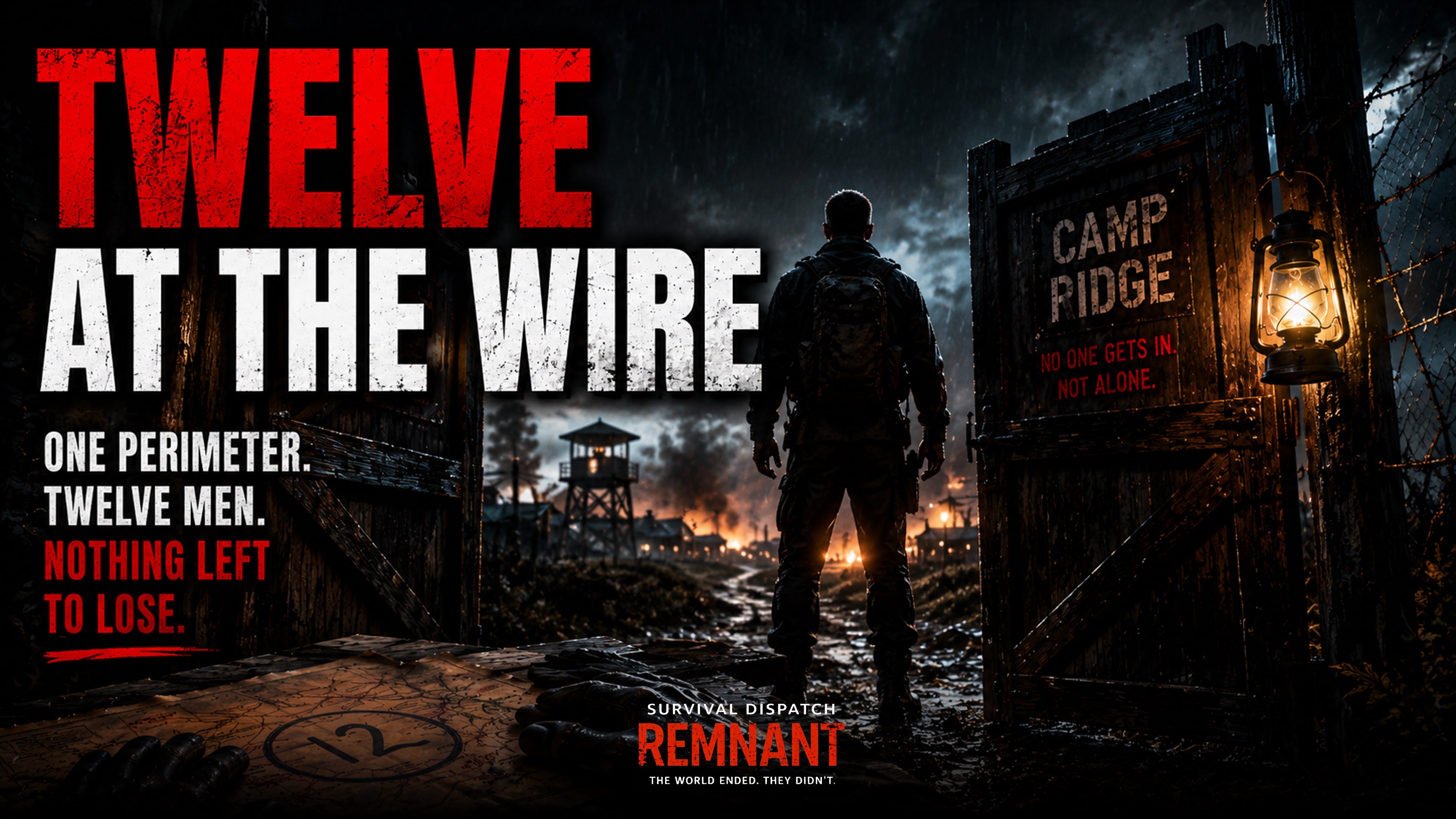
This is not a hypothetical built for a preparedness article. It is one of the oldest tactical dilemmas in the history of defended positions, and it does not get easier with experience. It gets more structured, because the commanders who survive long enough to develop experience are the ones who answered the question before it arrived, in a calm moment, with a protocol already written. The commanders who had not answered it in advance are the ones who made the decision on the spot under fire, and some of those decisions were right and some of them were catastrophically wrong, and very few of them were made with the clarity the moment deserved.
Camp Ridge faces this scenario this weekend.
The Black Vultures have been in the tree line all week. Twelve contacts counted at dusk on Sunday. Not advancing. Not retreating. Counting. The camp has known since John Moon’s overnight report that the probe was going to become something more, and Calloway has been positioning accordingly. The watch rotation is set. The sectors are assigned. The camp is as ready as four days of adjusted posture can make it.
What the camp is not ready for is the man at the gate.
Nobody planned for him. Nobody saw him coming. And in the middle of a perimeter breach, with the senior watch managing contact from the tree line, he is standing at the Camp Ridge gate asking whether there is room inside the wire for one more.
LISTEN TO EPISODES 11 & 12 THIS WEEKEND
Night Breach (Sat) and The Girl Who Saw It First (Sun) on Survival Dispatch Remnant
New episodes every Saturday and Sunday
Why the Gate Is the Most Dangerous Place in the Position
Every prepared defensive position has a fatal vulnerability, and it is almost never the section of the perimeter the commander spent the most time hardening. It is almost always the point of deliberate access: the gate.
The gate has to exist. A position with no way in is a position with no way out, which means it is a siege waiting to happen rather than a defense. So the gate exists. And because it exists, it is a decision point. And decision points under pressure are where positions fail.
The failure modes at the gate fall into two categories, and they pull in exactly opposite directions. The first failure mode is opening the gate when you should not. Compassion, urgency, or incomplete information drives a commander to let someone or something through the wire that should not be inside it. The position is now compromised from within, which is the hardest kind of compromise to recover from because it does not look like a threat until it is already too late.
The second failure mode is keeping the gate closed when it should open. A legitimate survivor is left outside the wire during an engagement and does not survive the night. Or the gate stays closed long enough that the man outside it becomes a liability rather than an asset, because he has now been observed by the same enemy that is probing the perimeter, and he cannot be safely released and cannot safely enter, and the position has created a problem it did not have an hour ago.
Both failure modes are real. Both have historical precedent. And both are driven by the same root cause: the gate decision was not pre-built. The commander who faces an unknown arrival during contact for the first time is making a genuine triage call with incomplete information under pressure, and genuine triage calls with incomplete information under pressure are the calls that produce the widest range of outcomes, from exactly right to catastrophically wrong, with no reliable way to predict which one you are making while you are making it.
Every secured position eventually faces the same question: what is the rule when a man you do not know is standing at your gate and the men who want to kill you are already in the wire?
The Four Variables That Determine the Right Answer
Commanders who have dealt with unknown arrivals at defended positions under contact consistently identify four variables that determine whether the gate should open, stay closed, or be held in a third state that most people do not think about until they need it.
Variable 1: Timing.
An arrival that happens before contact is a different problem from an arrival that happens during contact. Before contact, the position has the bandwidth to evaluate the arrival with something approaching deliberation. During contact, it does not. A protocol built for one set of conditions does not automatically transfer to the other. Positions that have only thought through the pre-contact arrival scenario will improvise the mid-contact one, and improvisation during contact is the source of most gate failures.
Variable 2: The arrival’s observable behavior.
Not what the arrival says. What the arrival does. A man who arrives at a gate under contact and immediately seeks cover, presents his hands, and stays out of the line of fire is behaving differently from a man who arrives at a gate under contact and moves toward the defenders, demands entry, or appears disoriented in ways that could indicate injury, impairment, or deception. Behavior is observable. Intent is not. The protocol has to be built on the observable variable, not the inferred one.
Variable 3: The position’s current capacity.
A position that is actively managing a perimeter breach has a specific and limited amount of bandwidth available for anything that is not the breach. The gate decision consumes some of that bandwidth. The question is how much. A protocol that requires significant command attention to execute during a contact event is a protocol that was designed for a lower-pressure scenario. The mid-contact gate protocol has to be executable by a single person, with a pre-built decision tree, in under thirty seconds, without pulling the commander off the line.
Variable 4: The third state.
Most people, thinking about a gate decision, frame it as binary. Open or closed. Let him in or keep him out. The third state is holding: the arrival is acknowledged, communicated with, positioned in a specific location outside the wire that provides some protection without granting access, and held there under observation until the contact event is resolved and the position has bandwidth to conduct a proper evaluation. Holding is not a permanent solution. It is a tactical pause that converts a mid-contact decision into a post-contact decision, which is almost always the better version of the same decision. The positions that have a holding protocol built before they need it are the positions that produce the best outcomes from unknown arrivals during contact.
Calloway has thought about all four of these variables. He has a protocol. He executes it this weekend. Whether it produces the right outcome depends on variables that no protocol can fully anticipate, because the arrival at his gate is not a generic scenario. He is a specific man, with a specific history, at a specific moment, and the decision Calloway makes about him will have consequences that run far beyond the night of the breach.
SUBSCRIBE TO SURVIVAL DISPATCH: REMNANT
What Calloway’s gate protocol reveals about the man he lets wait outside the wire — and why that decision costs more than anyone in the camp expects.
New episodes every weekend
— THIS ARTICLE CONTINUES FOR PAID SUBSCRIBERS —