


REMNANT SEASON 01 FIELD NOTE
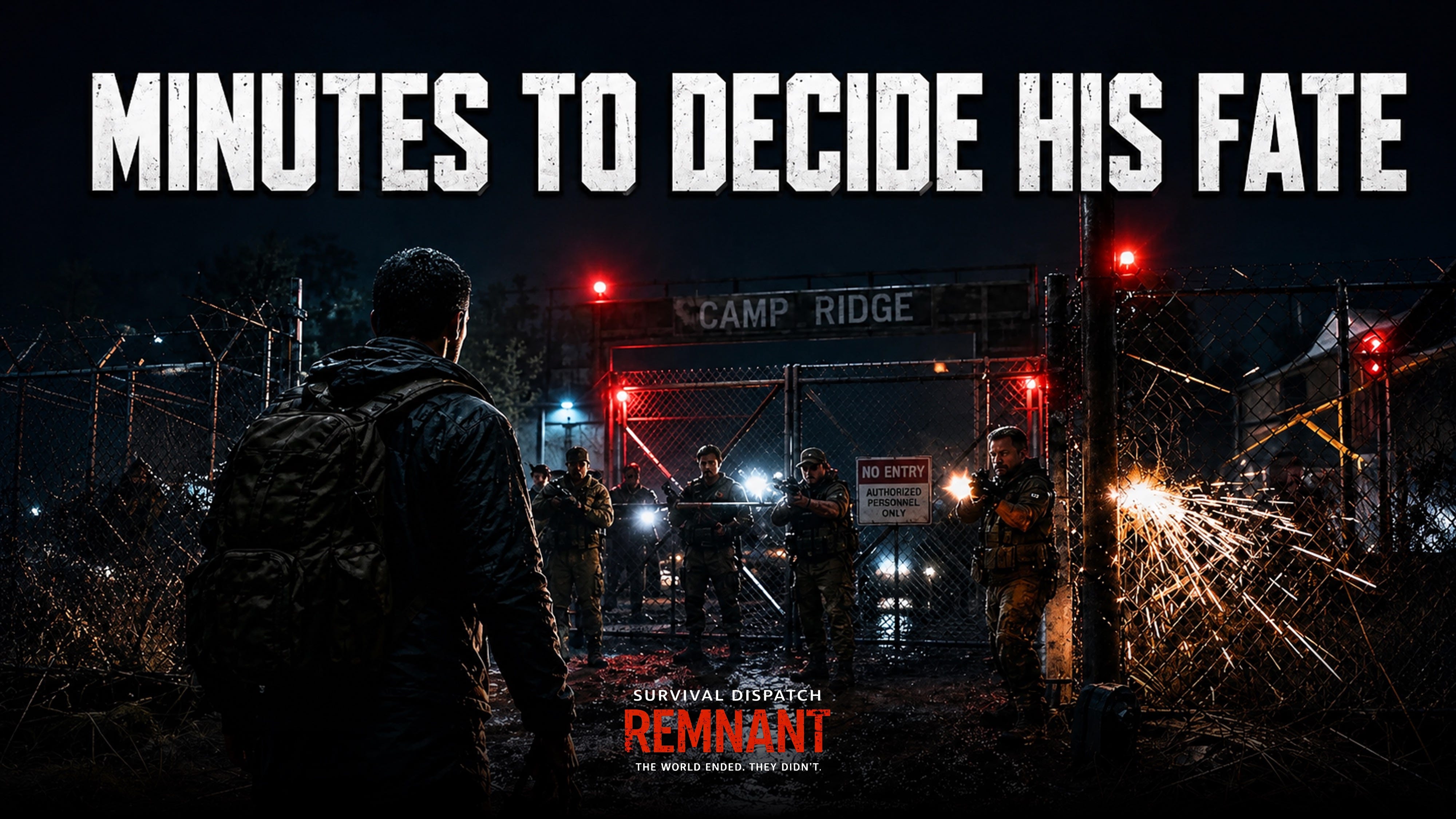
Gerald Phillips arrived at the worst possible moment.
Not at dawn, when the camp was running its standard intake protocol and Calloway had time to sit across a table from a man and read him slowly. Not in the quiet of a supply day, when the wire was secure and the only question on the board was whether a petitioner’s story held up under unhurried questioning. He arrived at midnight, on foot, alone, with a halogen flashlight pointed at a primer-red gate while bolt cutters were still working the eastern mesh thirty yards inside the camp and the sound of a Marked woman’s axe was buried in the pine boards of a tent platform.
He announced himself. He dropped his belt without being asked twice. He told Calloway there were three spotters tracking him from the hollow and gave the camp a timeline it needed. And then he stood perfectly still in the dark with his hands at chest height and waited while everything that could go wrong went wrong around him.
That is a specific kind of man. The question Camp Ridge had to answer before the gate latch dropped was which kind.
The Vetting Problem Has No Clean Ground
Normal intake assumes something crisis intake does not have: neutral space.
When a petitioner arrives under ordinary conditions there is time. You run the questions slowly. You watch his eyes when you ask about where he came from. You check his wrists and his gum line in good light. You give him a task that tells you something about how he thinks. You let him sit with your people at a meal and you watch how he listens. Standard intake is a slow filter with multiple passes.
Crisis intake is a single pass at speed with the worst possible signal-to-noise ratio.
A man arriving during active contact cannot be fully vetted before the decision has to be made. That is not a failure of the protocol. It is a fact of the situation. The noise of the contact is exactly the condition under which a sophisticated actor would choose to arrive, because it compresses the decision window to almost nothing and forces the gate to choose between two kinds of risk: the risk of letting the wrong man in, and the risk of leaving the right one outside.
Most groups never articulate that second risk clearly enough. Calloway did. He said it plainly at the red gate while the pines were still moving with the sound of a larger flock coming through the cuts. A perimeter is a promise. If we turn a good man away because we are afraid of a false shepherd then the wire is not keeping us alive. It is just burying us slower.
That is not naivety. That is a theology of risk that most purely tactical frameworks cannot produce, because it requires holding two true things at the same time: the man at the gate might be a threat, and the cost of treating every unknown as a threat is a camp that has already lost something worth defending.
SUBSCRIBE TO SURVIVAL DISPATCH REMNANT
Gerald Phillips is inside the wire. The vetting hasn’t finished. The full analysis of what his arrival means for Camp Ridge - and what it means for this weekend’s episode - continues below for paid subscribers.
Paid subscribers get each part the day they drop. Free subscribers wait one week.
— THIS ARTICLE CONTINUES FOR PAID SUBSCRIBERS —