

FIELD NOTE
The Smith family has spent ten days learning to read environments.
Not people, specifically. Environments. The way a neighborhood goes quiet in a particular direction before a threat materializes. The way a tree line holds still in a wind that should be moving it. The way a man’s boots tell you more about where he has actually been than anything that comes out of his mouth. The way Casey locks onto the second truck in the pine hollow because the first one is the performance and the second one is the intent.
This is the foundational skill of collapse survival, and the series has been building it from the first episode with deliberate and methodical patience. Mark runs the environment. John Moon runs the environment. Emily - twelve years old with a sketchpad in her lap - runs the environment from the outer camp at first light and sees the second probe forming before the senior watch does, because she is drawing the negative space instead of the objects in it.
What the series has not yet fully tested is whether that environmental pattern recognition transfers into a different category of threat.
Reading a perimeter for physical threat is a skill set. You are evaluating terrain, movement, shadow, sound, the behavior of animals, the gap between what the wind is doing and what the branches are doing. The inputs are physical and the anomalies are physical and the resolution - if you are reading it correctly - is physical.
Reading a controlled social environment for structural deception is a different skill. The inputs are behavioral. The anomalies are in timing, in language, in the specific gap between what a person’s words are doing and what their eyes are doing and what their body does in the half-second before their trained response catches up with the unstaged reaction. You are not evaluating terrain. You are evaluating whether the people in front of you are operating from genuine conviction or from a prepared script.
These skills are related but they are not identical. And the transfer between them is not automatic.
There is, however, one input that maps almost perfectly from physical threat assessment into social threat assessment. One signal that reads the same way regardless of whether the environment is a tree line at two in the morning or a room full of people who have been told what to say.
The anomaly.
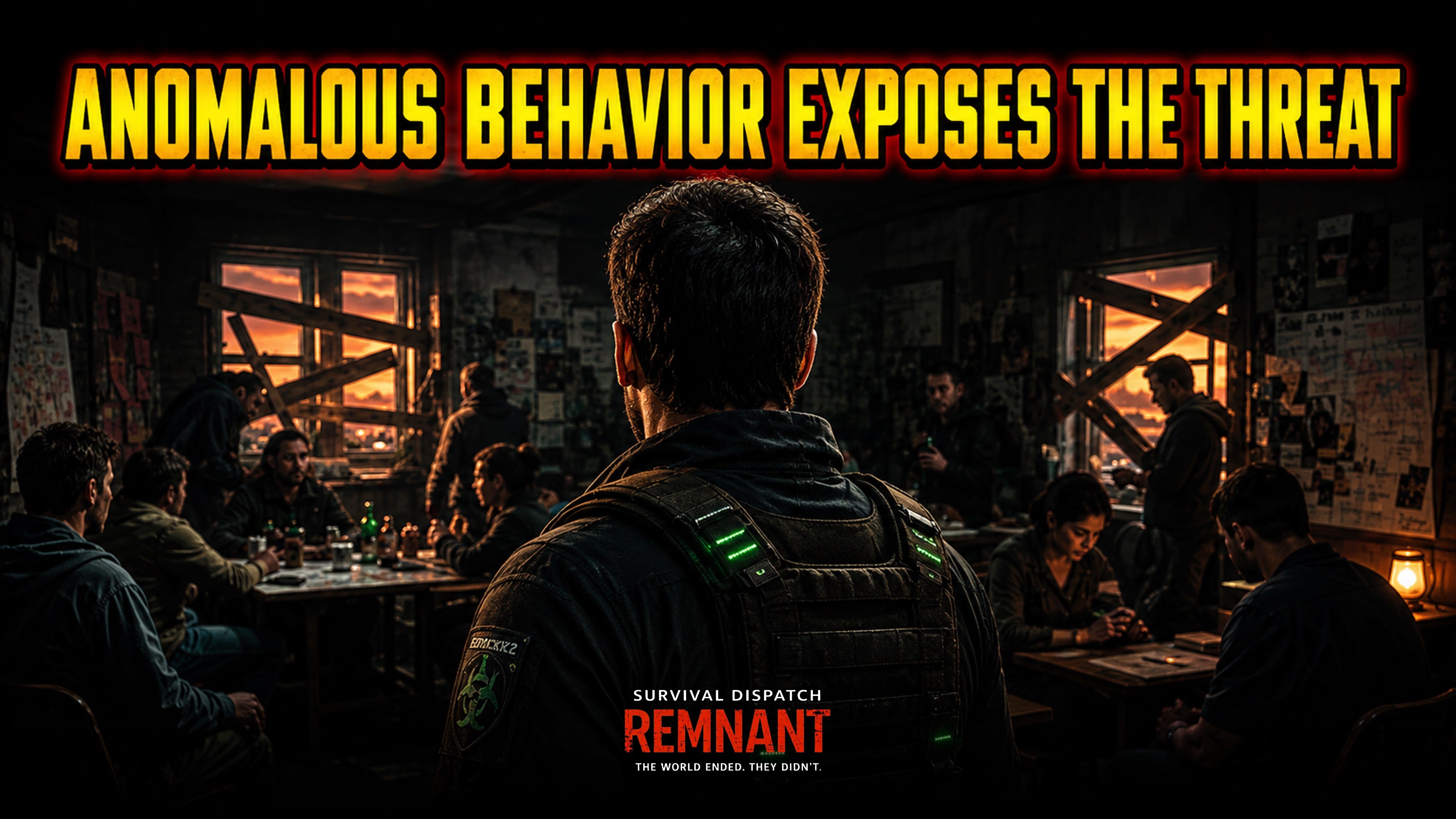
In a physical environment, the anomaly is the branch that does not move with the wind. In a controlled social environment, the anomaly is the person who does not move with the room. Every managed social environment - genuine or coercive - creates a behavioral baseline. People orient toward leadership. They use the group’s vocabulary. They respond to cues the same way, at the same pace, with the same register of affect. A controlled environment produces behavioral convergence, and that convergence is so consistent that a single person operating outside it - a person whose responses are not synchronized with the group’s rhythm, whose eyes move to the door instead of the speaker, whose affect does not match the room’s affect - reads like a branch in still air.
The one honest man in the wrong room is not invisible. He is the most visible person there, to anyone who has learned to look at the negative space.
The Smith family has been learning to look at the negative space since the first episode. What this weekend is going to ask is whether they recognize what they are seeing when the anomaly is a person rather than a gap in the tree line - and whether they trust that signal enough to act on it before the environment resolves around them.
SUBSCRIBE TO SURVIVAL DISPATCH REMNANT
Season 1 releases in two parts per episode. Paid subscribers get each part the day it drops. Free subscribers wait one week.
The full article continues below for paid subscribers.