


REMNANT SEASON 01 FIELD NOTE
The geometry that decides who comes back and who doesn’t.
There is a way a man drives when he knows he might not come home.
It is not nervous driving. It is not aggressive driving. It is something colder than either of those. It is the way a man drives when the road in front of him is not just a road anymore — when the asphalt and the tree lines and the abandoned vehicles and the unmarked side spurs have all stopped being scenery and started being terrain. When every curve is a possible ambush angle. When every overpass is a possible firing position. When every farm gate that has been opened recently is a possible staging point for whoever is going to try to take what is in the bed of the truck.
The Smith family has seen that look on Mark’s face exactly once before.
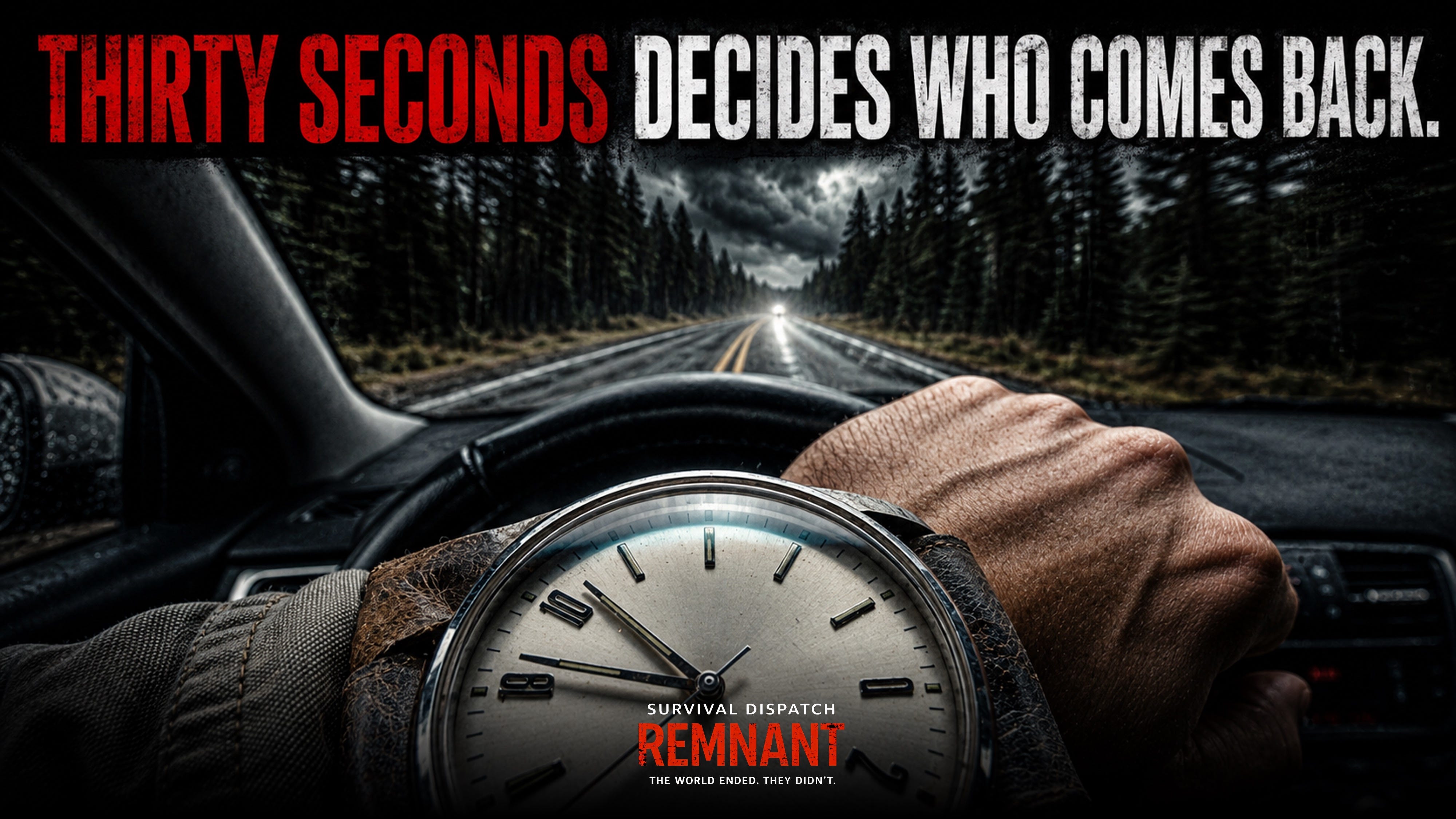
It was in Episode 5, on the water run, before any of them understood what scarcity actually does to a neighborhood. Sarah remembers it. So does Jake. Mark drove the truck out of the cul-de-sac that morning with both hands on the wheel and his eyes counting the houses as he passed them, and he was a different man by the time he got back.
This weekend, on Episode 9 of Survival Dispatch: Remnant, Mark drives a truck out of a different gate, on a different road, for a different errand, under different rules — and his eyes are counting again. Except this time, the truck is not his. The route is not his. The team in the truck is not his. And the man giving the orders at the gate is a stranger named Calloway who has run this exact errand on this exact route more times than the Smiths have been alive at Camp Ridge.
Calloway has lost good men on this route. He does not say so out loud. He does not need to. Every veteran scout in the F-250 already knows.
LISTEN TO EPISODES 9 & 10 THIS WEEKEND
SurvivalDispatchRemnant.com | New episodes every Sat & Sun
The Grocery Store Raid & No Safe Haul
Why the Road Is Always Worse Than the Building
There is an instinct in American preparedness culture that puts the destination at the center of every plan. The bug-out location. The supply target. The fallback site. The cache. Most family preparedness documents will burn three pages on what to do once you arrive and three sentences on how to get there. That ratio is wrong. It is exactly backwards from the way collapse actually kills people.
In every documented case of post-collapse supply movement — from the breadlines of Sarajevo to the food convoys of Mogadishu to the cartel-controlled fuel runs of northern Mexico — the overwhelming majority of casualties occur on the road, not at the destination. Not at the warehouse. Not at the depot. Not at the store. On the road in. On the road out. On the road that was supposed to be the safe part.
The reasons are simple, and once you understand them, you cannot unsee them.
A building can be entered through one of a small number of doors, cleared room by room, and held while the work is done. A road cannot be cleared. A road has infinite entry points and no fixed perimeter. Every tree line is an entry point. Every ditch is a firing position. Every farm lane is a staging area. Every overpass is overwatch. A vehicle moving down a road is a moving target on a fixed track at a predictable speed, and the men who want what is in the bed of the truck have all the time in the world to position themselves at the geometry that favors them most.
And here is the harder truth that most American families have never had reason to absorb. The road back is always worse than the road in. Because on the road in, nobody knows yet whether you are carrying anything worth taking. On the road back, everyone who saw you go through their territory has had time to confirm that you found something. They know you are loaded. They know you are slower than you were going out. They know the truck is heavier on the springs. They have moved into position. And the same road that brought you home empty an hour ago is now a kill zone with your name written on it.
On the geometry of supply runs in collapse: A road is not a path between two points. A road is a fixed track on which a man with a rifle and a watch can predict, to within thirty seconds, exactly when a loaded vehicle will pass any given tree line. The route is not the way home. The route is the half of the operation that the camp’s veterans worry about most.
The Five Things Every Route Is Actually Measuring
Experienced post-collapse operators — the kind who have spent careers studying vehicle convoy operations in places where the rule of law no longer reaches — consistently identify five qualities that determine whether a supply route is survivable, marginal, or already lost. These are not exotic indicators. They are the same factors that military convoy commanders have built doctrine around for the better part of a century, and the same factors that experienced criminals use to decide which delivery trucks to hit and which to wave past.
Most American families have never been taught any of them. Most American families, in a real collapse, will treat a supply run the way they treat a Costco trip. That is the assumption that gets the wrong people killed in the wrong order.
1. Predictability.
Routes get hit not because they are long, dangerous, or remote, but because they are repeated. The first run is statistically safe. The second run is statistically safe. The third run is where the predator has finally gathered enough data to confirm timing, vehicle, route, and load. By the fourth or fifth run, the geometry has been mapped. The team that runs the same route at the same time of day in the same vehicle is the team that is providing the predator’s research department with everything he needs to plan the engagement. Camp Ridge has run this route before. The fact that the Smith family is on this run, in this vehicle, on this day, is not random — and the men in the tree lines watching them go past have been watching this route long enough to know that.
2. Vehicle visibility.
Every vehicle on a post-collapse road broadcasts its load before it is ever stopped. The angle the truck sits at on its springs. The sound the engine makes under load. The dust kicked up off the rear tires. The way the driver takes corners. A loaded F-250 sounds, moves, and rides differently than an empty one. Predators read those signals at three hundred yards. By the time the team in the cab notices the silhouettes in the tree line ahead, the silhouettes in the tree line have already finished their math. The vehicle has told them everything they need to know.
3. Choke geometry.
Every route has points where the road narrows, the tree lines close in, the shoulder disappears, or a bend prevents the driver from seeing what is on the other side. Those points are where ambushes happen. Not because predators are sophisticated, but because the geometry of the road has already done most of their work for them. A team that has scouted its route knows every choke point on it. A team that has not scouted its route will discover its choke points the same way the predator discovered them — at the moment the engagement begins.
4. Reaction space.
Speed and following distance and turn radius and the available shoulder all combine into a single quantity that determines what the team in the vehicle is able to do in the first three seconds of contact. A vehicle moving too fast cannot reverse out of a kill zone. A vehicle moving too slow cannot accelerate through one. A vehicle following too close to a lead element cannot maneuver. A vehicle with no shoulder cannot get off the road. The team’s options in the first three seconds of the engagement are decided by the choices the driver made in the previous thirty seconds. Most of those choices, in most teams, are made unconsciously by men who were never taught they were making them.
5. Casualty handling capacity.
Every plan a team makes about a route assumes the team comes back the way it went out. Few plans seriously consider what happens when the team is short a man. The wounded man takes up space the haul was supposed to occupy. The wounded man requires hands that were supposed to be on rifles. The wounded man slows the vehicle, alters the driving discipline, and changes the math of every remaining decision on the route. A team that has not pre-decided what it will do with a casualty on the move is a team that will lose more than the one man it has already lost. Sarah Smith, holding the medical bay back at Camp Ridge while the foray runs, has thought about this. So has Calloway. Mark has not yet had to.
Episode 9 puts the Smith family on a route that has been run before, in a vehicle that broadcasts its load, with choke geometry that nobody briefs them on before they leave the gate. Episode 10 measures whether they make it home with everyone who left.
That is the whole arc of the weekend, compressed into two sentences. Saturday is the outbound leg. Sunday is the cost of the return.
SUBSCRIBE TO SURVIVAL DISPATCH: REMNANT
The full framework, the five questions every family should answer before the first foray, and the price the Smiths pay this weekend — for paid subscribers.
SurvivalDispatchRemnant.com | New Episodes Every Sat & Sun
— THIS ARTICLE CONTINUES FOR PAID SUBSCRIBERS —