


REMNANT SEASON 01 FIELD NOTE
There is a particular look a man gets when he realizes the people around him are testing him and he can’t refuse the test. It isn’t fear. It isn’t anger. It’s something quieter than that. It’s the look of a man counting what he has left to lose.
Mark Smith is wearing that look this weekend.
The Smith family has been at Camp Ridge for less than forty-eight hours. They were processed at the gate. Their weapons were inventoried. Their medical history was logged. They were assigned a corner of the outer camp and told that the first seven days are probationary — that the rules don’t bend for them yet, that the inner compound stays closed to them until they earn it, and that the only way to earn it is to do the work the camp asks them to do.
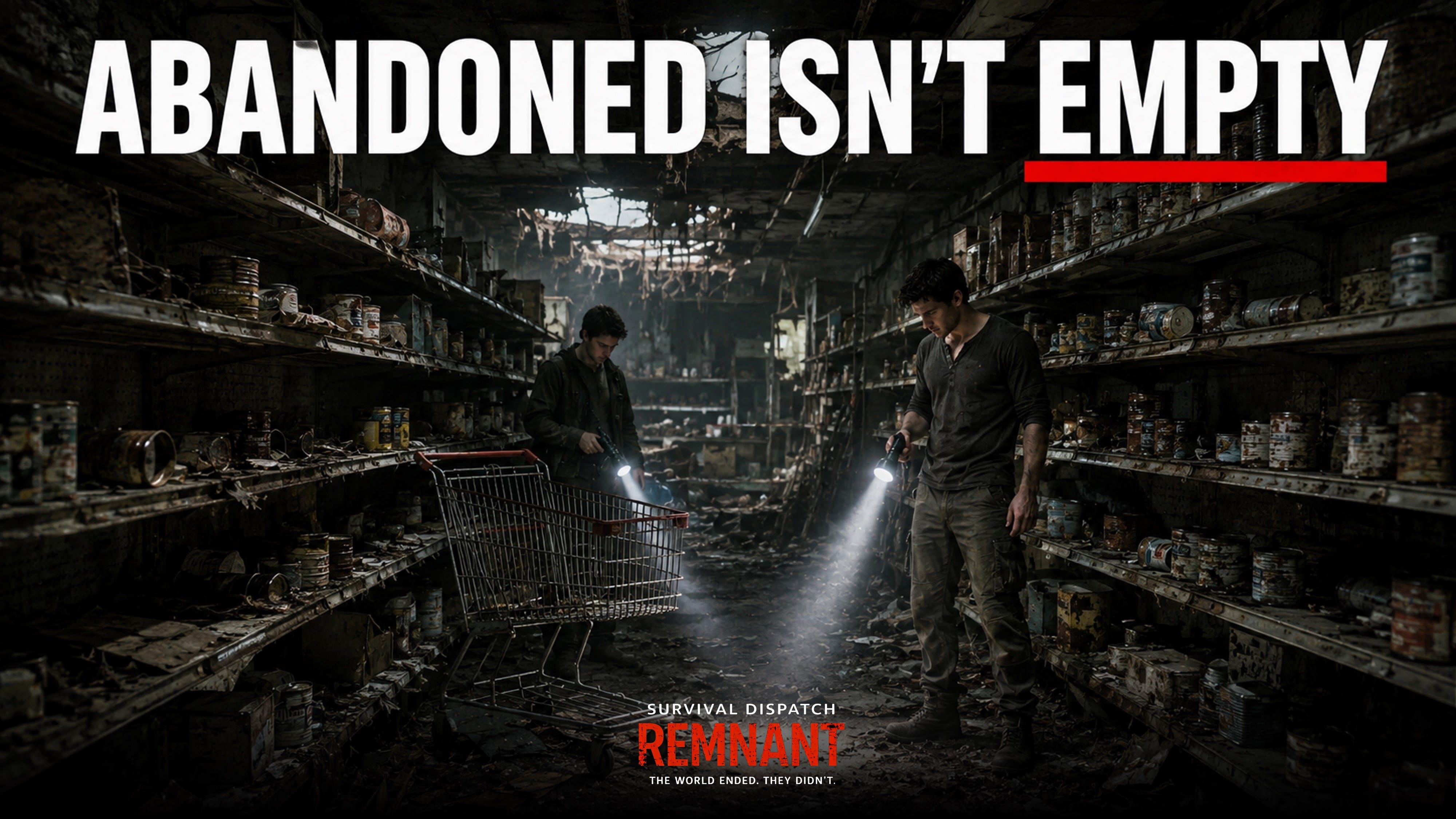
This weekend, the camp asks.
On Episode 9 of Survival Dispatch: Remnant — The Grocery Store Raid — the Smiths volunteer for their first probationary supply foray. A canned-goods run to an abandoned grocery store on a route the camp has run before. Nothing exotic. Nothing dramatic on the surface. Just the kind of routine errand that decides whether your family eats next week, and whether the men with rifles at the gate start calling you neighbor.
And on Episode 10 — No Safe Haul — the foray comes back.
That sentence has weight in it that the calendar doesn’t capture. Because every man who has ever pulled a load through hostile country knows the truth about supply runs in a collapsed world: leaving the gate is the easy half. The hard half is what’s chasing you on the way home.
LISTEN TO EPISODES 9 & 10 THIS WEEKEND
SurvivalDispatchRemnant.com | New episodes every Sat & Sun
The Grocery Store Raid & No Safe Haul
The Test You Don’t Get to See Graded
Every survival group that has ever functioned for more than a few weeks runs on the same quiet engineering principle: the people inside the wire have to be able to trust the people inside the wire. There is no room for guesswork. There is no margin for the man who looks ready but breaks under pressure. There is no time to discover, mid-firefight, that the family you admitted last Tuesday won’t pull a trigger when it matters.
So the group tests them.
Sometimes the test is announced. More often, it isn’t. A new family is given a job that looks ordinary and turns out to be the exact pressure point where character shows. Pastor Calloway, who runs Camp Ridge, has been doing this long enough that he doesn’t bother to explain the system to the people inside it. He just asks for volunteers and watches who steps forward, who hesitates, who steps forward for the wrong reasons, and who is still standing when the work is done.
Mark Smith has been read by men like that his entire adult life. He knows the look. He knows what’s being measured. And he knows that the only wrong answer is the one that keeps his family in the outer camp another week while strangers decide whether the Smiths get to live behind the inner wire or not.
On the difference between earning your standing and being given it: A family that is given safety holds onto it the way a man holds a loaned tool. A family that earns it holds onto it the way a man holds the rifle he carried home. Camp Ridge has been alive this long because Calloway knows the difference, and because he refuses to confuse one for the other.
The Five Things Every Foray Is Actually Measuring
On the surface, a supply foray is about food. Cans, dry goods, medical, fuel — whatever the camp’s logistics ledger says it’s short on this week. That’s the cargo. That’s not what’s being measured.
Veteran post-collapse operators — the people who have studied real-world foraging behavior in everything from Sarajevo during the siege to the cartel-controlled zones of northern Mexico — consistently identify five qualities that experienced groups are testing for when they send new members outside the wire for the first time. Not all five have to be present. Two or three together, observed under pressure, is usually enough for the camp’s leadership to make a decision that the new family doesn’t even know is being made.
1. Composure when the plan changes.
Every foray plan survives intact until the first contact with the real world. Doors that should be open are barred. Routes that should be clear are blocked. Buildings that should be empty are not. The camp wants to know what your face does when the briefing stops matching reality. Panic is a disqualifier. Hesitation is a question mark. Quiet adjustment is the answer they’re looking for, and it can’t be faked under pressure.
2. Discipline around the haul.
Greed kills more supply runs than ambushes do. The man who keeps loading after the team calls time. The family that lingers in the aisle to grab one more case. The volunteer who breaks formation to clear a back room nobody asked him to clear. The camp is watching whether your hands know when to stop. The haul is not yours. The haul belongs to the camp that fed you last night. Acting like it doesn’t is the fastest way to never leave the outer wire.
3. Recognition of who is on your flank.
A foray is a fire team, not a family outing. The veterans on the run are watching whether the new arrivals look at them, talk to them, signal to them, and move with them — or whether they treat the foray like a private grocery trip with strangers attached. The camp wants people who already understand they are in a unit. People who don’t understand that get one foray. People who fight it get none.
4. Response to first contact.
Sooner or later — usually sooner than the briefing suggested — the foray makes contact with something that doesn’t want to be made contact with. It may be opportunists. It may be something worse. The camp’s veterans already know what they will do. They are watching to see if you do. Hesitation is read. Overreaction is read. Disciplined aggression, the kind that doesn’t escalate beyond what the moment calls for, is the rarest answer and the one that gets a family invited to dinner inside the inner compound.
5. Who you stand next to on the way back.
The return trip is when a foray actually settles its account. The work is done. The pressure is in the rearview, or it’s behind you and closing. The camp watches whether the new family clusters together for their own protection or whether they spread out across the team and carry their share of the load home. The man who shields his own and forgets the rest of the column has told the camp everything they need to know about who he will be the night the perimeter takes a hit.
Episode 9 puts Mark, Sarah, Jake, and the Moons through all five of those measurements inside of a single afternoon. Most of them, they don’t know they’re being measured on. One of them, Mark sees coming from the moment Calloway opens his mouth.
And one of them — the one that comes after the haul is loaded and the foray turns for home — is the one that Episode 10 is built around. Because Sunday’s episode is the answer to the question Saturday’s episode asks. And that answer is not free.
SUBSCRIBE TO SURVIVAL DISPATCH: REMNANT
The full framework, the five questions every family should answer before the first foray, and the price the Smiths pay this weekend — for paid subscribers.
SurvivalDispatchRemnant.com | New Episodes Every Sat & Sun
— THIS ARTICLE CONTINUES FOR PAID SUBSCRIBERS —