


REMNANT SEASON 01 FIELD NOTE
Mark Smith isn’t a quitter.
That’s the thing you have to understand about him before you can understand what Episode 7 costs him. He is the kind of man who commits. He digs in. He defends. From the moment the skyline turned orange on Day Zero, he has been organizing, hardening, and holding the ground his family stands on. The house is not just shelter to Mark. It is proof that he is still in control of something.
And now it’s burning.
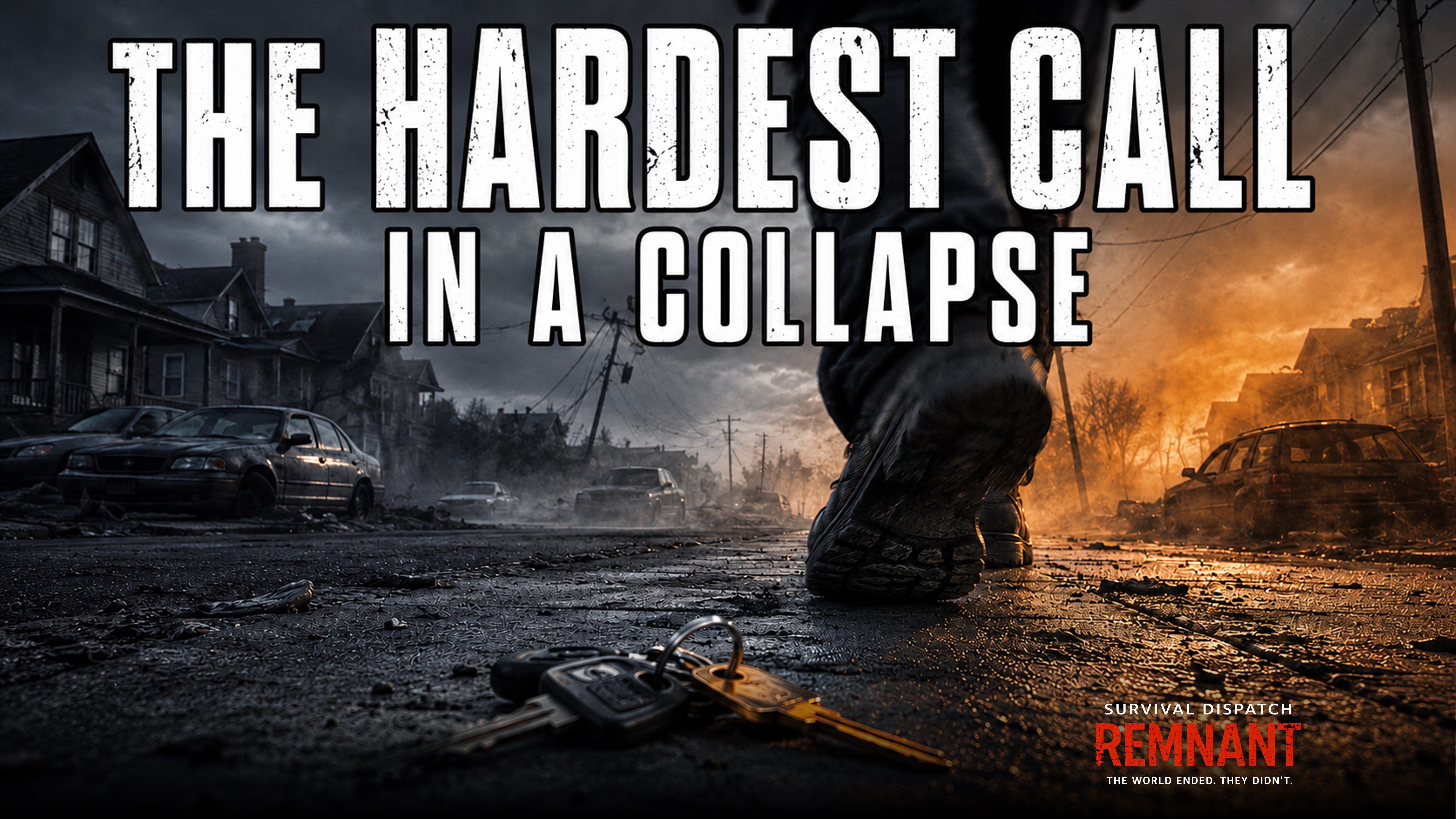
Not metaphorically. The house down the block is genuinely on fire, the smoke is moving wrong, and the neighborhood that was already coming apart is now doing it faster. The Smiths have maybe twenty minutes before staying stops being a decision and starts being a sentence.
This week on Survival Dispatch: Remnant, Mark makes the hardest call of the collapse so far. Not the headshot. Not the barricade. Not the door.
He tells his family to pack what they can carry and get to the truck.
If you’ve ever owned a home — if you’ve ever worked for something long enough to be proud of it — you already know why that sentence hits like a gut punch. And if you’re serious about survival, you also know that Mark’s instinct to hold on is exactly what gets families killed.
Here’s why. And here’s how real families learn to read the signals before the fire decides for them.

THE LIE EVERY PREPARED FAMILY BELIEVES
There is a persistent fantasy in the preparedness world that goes something like this: you buy the supplies, you harden the house, you know your neighbors, and when it gets bad you shelter in place until the trouble passes.
That fantasy is built on one massive, silent assumption.
It assumes that your location remains an asset.
For the first 72 hours of a real collapse event, that assumption usually holds. Infrastructure failure, initial panic, and the psychological shock of the event itself create a window where being inside a known structure with water and supplies and people you trust is almost always the right call. Sarah Smith built the family’s preparedness protocol around exactly that window. She was right.
But the window closes.
The question is not whether your position will eventually become indefensible. In a sustained collapse, it will. The question is whether you will recognize when it happens — or whether you will stay inside the burning building because leaving feels like losing.
ON THE DIFFERENCE BETWEEN A POSITION AND A HOME:
A home is where you raised your children. A position is where you are standing right now. Collapse turns the first into the second. Men who refuse to accept that distinction tend to die in houses their families should have left three days earlier.
THE SIGNALS THAT MEAN IT’S TIME
Military doctrine has a concept called the “tactical withdrawal” — the deliberate decision to break contact with a position because holding it costs more than it is worth. The problem with applying that concept to a family home is that the man of the house is almost never neutral about the math.
Mark Smith isn’t neutral. He built a defensive posture in that house. He knows every angle, every entry point, every field of fire from the second-floor windows. Leaving means abandoning all of it. It means admitting that the work he did wasn’t enough. It means stepping off the only ground he actually controls into a world he cannot predict.
That emotional weight is real. And it will kill you if you let it.
Experienced survival planners — people who have studied real post-collapse behavior in everything from Hurricane Katrina to the Bosnia siege — consistently identify five signals that a position has shifted from an asset to a liability. Not all five have to be present. Two or three together, in combination, typically constitute a decision point.
1. FIRE IN YOUR IMMEDIATE ENVIRONMENT.
Not a house fire two neighborhoods away. Not smoke on the horizon. Fire that is moving toward your position with wind behind it, or fire in an adjacent structure that your position shares a roofline, utility connection, or vegetation corridor with. Smoke inhalation incapacitates people faster than most realize, and a family trying to shelter from a fire in an adjacent structure is making a bet against physics.
2. COMPROMISED PERIMETER SECURITY ON MULTIPLE SIDES.
One direction of threat is a defensive problem. Two or more simultaneous directions means your position has been identified, profiled, and is being approached with intent. The Smiths learned in Episode 6 that the ambush-dormer connection was not random — someone mapped them. A family that has been mapped is a target, not a position.
3. WATER AND FOOD BELOW MINIMUM THRESHOLD.
The exact number depends on your group size and physical output, but the principle is fixed: when you drop below 72 hours of water and cannot resupply from within your defensive perimeter, you are no longer defending a position. You are waiting in it. Those are different things.
4. MEDICAL NEED THAT CANNOT BE ADDRESSED ON-SITE.
Sarah Smith’s nursing background is one of the Smith family’s greatest assets. But even she cannot perform surgery on a kitchen table without supplies. When a member of your group has a medical need that exceeds your on-hand capability and cannot be delayed, movement becomes a medical decision, not a tactical one.
5. LOSS OF INFORMATION ADVANTAGE.
The Smiths knew their neighborhood. They knew the Halverson house. They knew the sight lines. The moment that information was neutralized — by fire, by the dormer figure escaping, by spreading chaos they could no longer track — they lost the ground truth that made their position defensible. A position you cannot see is a position you cannot hold.
In Episode 7, Mark is looking at signals one, two, and five simultaneously. That’s not a close call. That’s a decision that should already be made.
The harder question — the one the episode actually explores — is why it still feels like losing.
SUBSCRIBE TO SURVIVAL DISPATCH REMNANT
The framework, the five questions, and what the Smiths got wrong follows.
— THIS ARTICLE CONTINUES FOR PAID SUBSCRIBERS —